Showing posts with label math. Show all posts
Showing posts with label math. Show all posts
10.27.2022
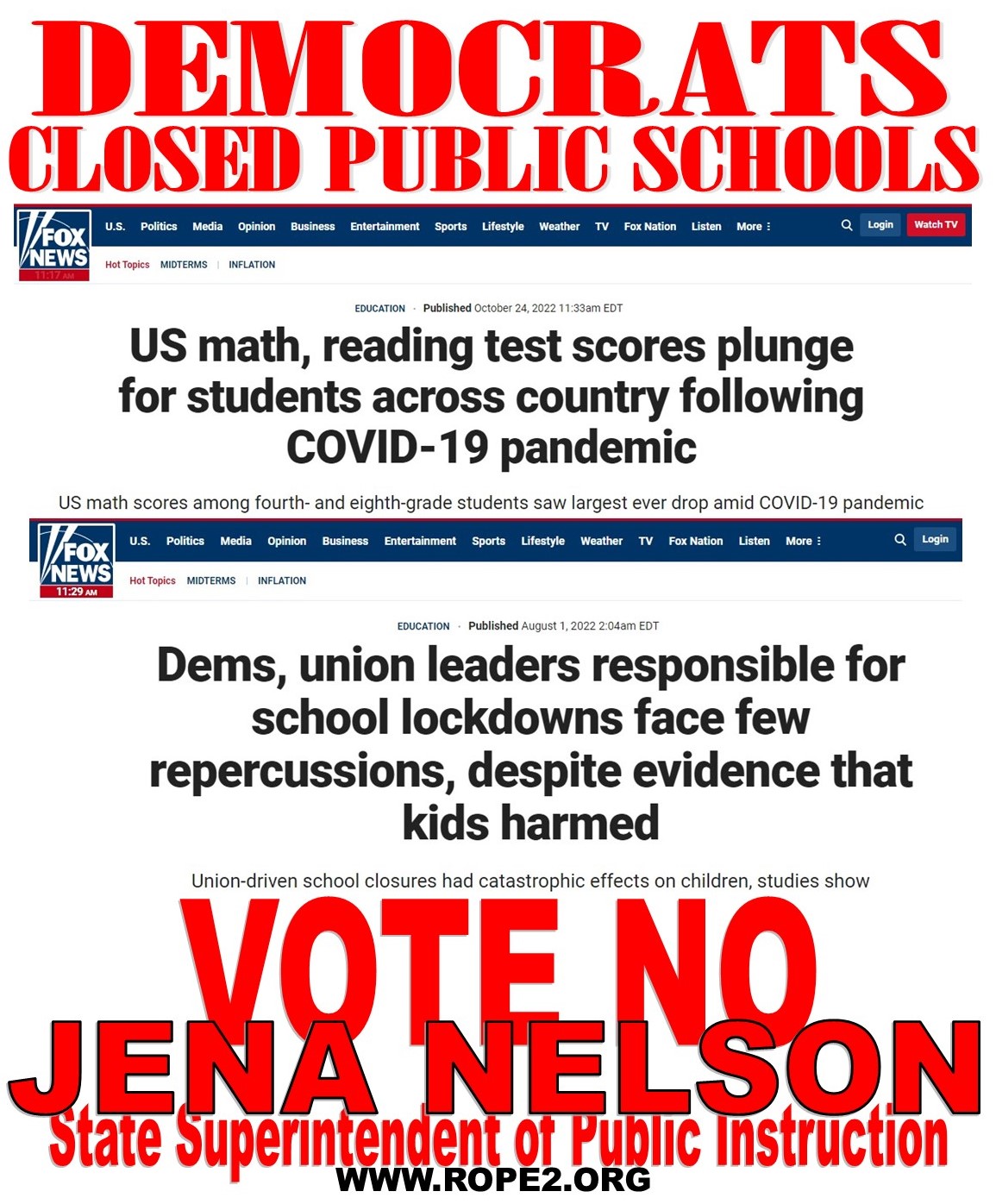
Democrat Education Policies DAMAGE Kids – VOTE NO FOR DEMOCRAT JENA NELSON for State Superintenden

2.08.2016
It's Vitally Important That Oklahoma Get The Standards Re-Write Process Right - Other States Are Watching

Thursday, January 28th, the final draft of Oklahoma's new academic standards were published on the OSDE website and approved by the State Board of Education. We described our thoughts about the process in a press release, but I wanted to take a few more minutes to expound upon that statement.
Once the Common Core State Standards were repealed from law by HB3399 and the direction of the process for creating new standards was revealed, we have tried our best to stay informed about the proceedings and inform you.
10.07.2015
Draft #3 of Oklahoma Educational Standards Released - Neither Stotsky Nor Gray Impressed

The Southern Regional Education Board, The Partnership for 21st Century Learning and the South Central Comprehensive Center. Since the first draft, we have complained that none of the standards reviews have been made public - which is why we began publishing our own - unfortunately, these are all organizations involved in 'education reform' at some level. In fact, we've written papers about the Partnership for 21st Century Learning and the fact that the white papers supporting its mission are steeped in the failed progressive education methods of Dewey.
The South Central Comprehensive Center has this to say about its funding and mission: The South Central Comprehensive Center (SC3) is part of a national network of centers funded by the U.S. Department of Education (ED) to support the improvement of educational outcomes. If that's not the definition of the Fox Guarding The Hen House, what exactly is?
Only the Southern Regional Education Board appears to be moderating away from Common Core, but its white paper on College and Career Readiness indicates the need for states to create a 'default high school CURRICULUM' - something that should concern any local control proponent. At any rate,these reviews should be read by the general public with these facts in mind.
Not long after the release of the 3rd draft, Nate Robson of Oklahoma Watch penned a nice article detailing Dr. Sandra Stotsky's thoughts on the new standards which included the statement,
“You’re close to the bottom of the basement, I am sorry to say, because there is no content in them,” said Stotsky. “These are pious statements of academic goals. These are not standards. A standard is a criterion by which you grade something.”
Ouch. Professor Stotsky is now forced to provide basic educational definitions to the Standards Re-Write Committee - not a sterling commendation to say the least - but there is a question here Robson dances around; Why invite three separate 'experts' to testify to the Standards Writing Committee detailing the process for writing excellent educational standards, yet then invite three different ORGANIZATIONS tied to the education establishment to write reviews for the 3rd revision of the standards? Why not just go back to the original sources? It's what Robson did. Maybe that was the unchosen path for a reason. Maybe the department knew the writing committees hadn't been following the expert advice provided the Standards Committee. Maybe they didn't want the experts coming back to salt the ground they'd originally plowed for the OSDE.
The impetus matters not, actually. What matters is that both Stotsky (English) and Gray (Minnesota math) were not generally complementary of the 3rd standards draft to Robson, and this has sad implications for Oklahoma students.
Below are the specific comments provided by Stotsky (Gray's can be found in the Oklahoma Watch article)
1. Under "Critical Writing"--Most writing standards do not lead to an assessment of the kind of writing done in college or the real world of work. OK's draft organizes the writing standards under "narrative," "informative," and "argument."
The “narratives” (most of which is creative writing) are curriculum-relevant chiefly in the early grades and are not desirable in college or the world of work. "Informative" is fine, but "argument" should be changed to "persuasion" and "opinion" eliminated in the elementary grades. Only "informative" prepares kids for college and career writing.
More important, why can’t OK require all local school districts to assign and assess a research paper or senior thesis for English and history or science in grade 11 and/or 12 to prepare students in an authentic way for college and career. That is precisely where authentic research standards, as in the strand in my 2013 document. should be assessed.
2. The "Critical Reading" standards should NOT be divided into Literary and Informational. That is pure Common Core and it is very bad for the English curriculum. The Critical Reading standards should be divided into (1) Fiction, (2) Nonfiction, (3) Poetry, (4) Dramatic Literature), and (5) Classical and Traditional literature. That's what English teachers have always taught and been trained to teach.
3. The OK drafting committee must come up with an example of a literary text that could be used (and how) for every single standard so that teachers understand what reading level is required or desirable at every grad level (and what the standard means). Make it clear these texts are not required; only examples of reading levels.
4. Get rid of processes for reading and writing in this document. They are not standards but pedagogy.
5. Get this ELA committee to put in Oklahoma-related reading standards at the high school level--grades 11 and 12. One standard for texts by major authors born in or who wrote about Oklahoma, and one standard for biographies/autobiographies about famous Oklahomans through history.
8.14.2014
Why I Choose To School My Children At Home And Why I Think You Should Too
 by Jenni White
"Mom, are you going to check my paper?" Sam, my youngest, is sitting next to me doing math right now, but because I'm attempting to write a blog, I ask him to hold on a minute. Don't worry, he'll ask again in 5, 4, 3, 2, 1...
"Ok...let's look..." I answer, swinging away from my keyboard.
Obviously, I did not choose to homeschool my children so that I could get more done for ROPE. I'm sure homeschooling and peace and quiet can be synonymous, but I don't find that often in the White house anymore.
It's not always been this way. My kids haven't always been homeschooled.
In fact, when my husband David and I had our first son, Coleman (we also have a married daughter, Bryna, 31) he and I left our little self-remodeled 50's bungalow for a bigger house in the neighborhood where I grew up - so he could attend a 'Blue Ribbon' public school - we never even considered anything else.
Coleman - and our adopted daughter Betty - started half-day kindergarten at that little school in 2007 and I was irritated they were only going a half day. It made no sense to me that other schools had full day kindergarten and mine had only half. I joined PTA, went to every Kindergarten presentation, helped them with their reading every evening and enjoyed both kids' teachers tremendously.
In 2008, the school offered full year kindergarten and by 2009, I was standing in line so Sam, could be in half-day pre-k.
During the end of 2008, something began to change in me. Until this time, I was a pretty typical stay-at-home mom; cleaning house, making meals, doing laundry and very involved in my church. I did have a home business I began in 2003 named for the son we lost between Coleman and Sam (MarshallsMemories), and I scrap-booked and made jewelry in my 'off' hours, selling my wares mainly on Etsy.com, but other than that, nothing remarkable.
Though I had voted in nearly every election since I was 18, I had never really been involved in 'politics'.
I registered Republican at 18 (I adored Ronald Reagan) and, excepting a fall from the wagon with Clinton's first term, I found Republican ideals more suited to my own. Voting was one thing; researching a candidate's voting record or background, another. That had never been on my radar screen, yet toward the middle of '08, I began researching then-presidential candidate Barrack Obama and became concerned about what I found. Never before much interested in America's form of government, civics or history, I suddenly wanted to know as much as I could about as much as I could. The more I found out about Communism, Marxism and America's Republican form of government, the more I became convinced public schools had, by and large, simply quit teaching the fundamentals of American history and government.
One thing led to another with my research and by 2010, a friend (Julie McKenzie) and I had started ROPE as a way to shed light on the fact that American students were graduating high school with little to no education in the founding of our country and the science of civics. In fact, ROPE's first stab at legislation was to make sure kids were reading American foundational documents. From there, we began studying public school funding and many, many other topics relating to the education of our youth across Oklahoma and America.
Interestingly, I spent the first several years of my career as ROPE president, researching and writing about public school issues after dutifully seeing my kids off to school. In fact, I remember complaining bitterly when school was canceled for snow or cold, or there was an assembly. My property taxes were going to pay for this school to be open, why wasn't it? My kids needed to be in school, not sitting around home watching TV.
I knew there were parents out there who schooled their kids at home yet I thought them only slightly sane. Why would anyone bring their kids home for school? How were they going to get a good education? Parents weren't teachers for Pete's sake, what parent thought they could adequately educate a child for college by keeping him home? Even having been a teacher - even with a Master's Degree in Biology - this thought was anathema. I was fairly certain homeschooled kids did little but run around their neighborhoods during regular school hours, driving their scooters in front of cars like a homeschool family that moved (briefly) into our neighborhood. How in the world did these kids make friends? Who was around to hang out with during the day? None of this made any sense to me.
As a Christian, I had also come to believe that my Christian children could be salt and light to nonbelievers at their school. Why would I even think of removing my kids from public school when they could be leading others to Jesus within the confines of the school room walls?*
Throughout the years, I was active in PTA at the school. I tried to attend every meeting I could and did what I could to help out with PTA functions. One day at a PTA meeting, I spoke up and asked why we were raising so much money for the school (we had 10's of thousands in the school PTA account). I was told it was for the school's computer lab and to pay for a new gymnasium that we could use during the week and rent out for basketball games/practice on the weekends. Once, when I opined that elementary kids didn't really need to learn how to operate computers, I had the immediate and distinct notion I had broached the unbroachable. It was clear these kids MUST have computer time or they would fall behind their peers at other schools - did I want our kids to be computer illiterate? I had just read research indicating that electronics for elementary-aged kids can prevent them from focusing by shortening their attention span, so I shared this. Clearly, no one in the room was interested.
After studying traditional math (in comparison to the Common Core) I shared - at another meeting - that our school should NOT be using Everyday math, but instead adopt Saxon or Singapore texts. This revelation was met with disinterest in the least and consternation at worst. For a number of months I tried to get other parents/teachers on board with the idea, but our Principal finally put the hex on the idea by reporting that the school couldn't afford the textbooks. PTA, of course, needed their money for a computer lab and gymnasium. It was then I realized that even math illiterate kids can get on the computer and play roundball, and maybe my ideals about education weren't those of my fellow parents or school.
No matter how many children you have, no two will be alike. I have four, and while none of them are carbon copies of one another, I managed to get a more introverted boy and a girl and a boy and a girl who love going and doing and being right in the middle of everything. Coleman is one of my introverts. From a young age that kid would sit by himself, perfectly content building Lego's or drawing, so I shouldn't have been surprised when during the middle of a VERY TOUGH 3rd grade year (lots of bullying and an overbearing teacher who didn't like my son much), he came to me crying and begging me to homeschool him.
What? He was just having a reaction to the year, I was sure, yet even after he was moved to another class to try and make it easier for him to learn, he would regularly beg me to keep him home for fourth grade. Two things happened fairly quickly near the end of that year; a homeschooling mom joined the ROPE board and she began sharing personal experiences about her homeschooling, and Coleman fell face first off the swings, and was made to sit in the office with his face so swollen he could barely open his eyes until they finally got around to calling me. That was it. Though I wasn't sure how the whole schooling the kid at home would work, I decided to take on the challenge and my husband reluctantly agreed.
If I hadn't been seen as the bizarre white-haired White lady at that school before, I was by the first day of school 2010-2011. I enrolled Sam and Betty in 1st and 4th grades respectively, while submitting a letter to the office that I would be schooling Coleman at home and signing up for another year of PTA - this time with the intention of running for President.**
I began Coleman in Classical Conversations that year. One day a week I went to an Edmond church 'campus' where kids of all ages and stages came together to learn all sorts of facts about all sorts of things. In the morning, Coleman had Foundations (the facts portion of the curriculum) and in the afternoon he had Essentials of the English Language where he learned to diagram sentences and write essays. At home during the week while his siblings were in school, Coleman would study his facts, practice his English assignments and write a paper on a different topic each week. I added Saxon math and had him read and outline a junior classic book every couple of weeks. Though I suspect both David and I thought he would soon tire of the self-paced work and lack of friendship, he blossomed, and I learned more about traditional (classical) education vs the progressive education taught in most public schools today.
ROPE had just taken on Common Core and I was speaking and writing and lobbying frequently at this point. Disinterested with the idea of hanging with Mimi or Grandmama during many of my outings, he chose to come along to the Capitol, to meetings - wherever I was headed - and he had a blast (most times!).
Meanwhile, I was still following what the other two were doing in public school, but by now my eyes had fully opened and I was beginning to see the light. The assignments Betty brought home from school made my new blog (begun in July of 2011) several times, as did school newsletters and other items. Her fourth grade teacher and I did not see eye-to-eye and her deeply progressive, rude, student teacher nearly caused my husband apoplexy after a meeting scheduled to discuss some of her more interesting worksheets on Global Warming and Native Americans.
First grade wasn't treating Sam any better. His teacher should never have been responsible for an elementary classroom. She was, if anything, more equipped to muscle around teen children - she had absolutely no empathy and seemed to have cared less for little ones in general. Certainly a Common Core apologist, she was proud to tell me that our school was an early adopter of the standards, knowing the state would force the issue the following school year. During his tenure in her first grade class, he learned to spell words like Kapok Tree (thanks to the chapter on rain forest deforestation) while learning nearly zero English grammar mechanics for spelling (i before e except after c, etc.). Even today, that kid can spell very, very little no matter how hard I have tried to teach him by phonemes. Then there was the math. Oh my word. Though my child could easily be classified ADD, I have no doubt in my mind that his math experiences in first grade are what set him back at least two grades and made him absolutely detest the subject. The fact that he can't sit still and concentrate doesn't make him hate math, it just makes him hate sitting down for any length of time.
By the end of 4th and 1st grades in public school while homeschooling one simultaneously, I had simply gotten to the point where I had zero compunction about removing the other two kids lock stock and barrel from public school and pulling them onto the CC campus with Coleman. I'm sure the school was absolutely ecstatic to see me go, and we were just as pleased to leave.
And there you have it. The genesis of the White family homeschool experience.
Today, we're still with Classical, but we're now at a campus well outside the city, near the little town where we've moved to start a farm. Apparently, once you jump off one conveyor belt, it's becomes easier to jump off the rest (packaged food vs fresh food, internet news vs Big Media news, classic shows on Netflix vs commercial television - we've jumped off them all). Sadly, as I look back, I see how brainwashed Americans - especially mothers - have become. We women bought into that 'bring home the bacon, fry it up in the pan' mentality back in the '70's and now we have no qualms dropping off even our youngest children to be raised by someone other than ourselves during the day while we are at work.
I did the math one day. Did you know that each year your child/children are in school, you are allowing someone other than yourself to influence your children 1,190 hours = 50 days = 14% of a year? Did you know that every year our state/federal government want your children to be in school MORE hours and MORE days? How many can you lose and expect your child to graduate high school (let alone college) comfortable with your set of values?
Don't get me wrong, I'm not saying that homeschooling is the panacea for producing 'perfect' people (how about that for alliteration!?) - there is no formula for perfection and there is only One that was - I'm simply saying that the more you influence your child, the less someone else is influencing your child.
Neither am I saying that all homeschools produce excellent results, or are done for the right reasons or should be held up as education models for all to see. I am saying, however, that more parents are equipped to homeschool than are. I'm saying that more parents can homeschool than think they can. I'm saying many parents don't even entertain the option because they think themselves ill-equipped.
Over twenty years ago when people like my friends, former state representative George Faught and his wife Becky, began homeschooling their children - in the days when people in IGA would call the truant officer because Becky had her kids in the store while she shopped - there were very few resources for parents that wanted to homeschool. This isn't the case today. Today there are wonderful online resources (not K12 or other online schools associated with state public schools) such as Freedom Project Education, and others such as Sonlight and A Beka that can provide excellent road maps to an excellent education for ANY parent, regardless of educational background.
As I've said many times in many different venues, God blessed you with your children. He gave them to you to raise, not to a school or a teacher. We are admonished to "Train up a child in the way he should go: and when he is old, he will not depart from it" (Proverbs 22:6), and that admonition is for parents directly, not through teachers or schools indirectly. Though I in no way mean to embarrass or anger parents who choose to send their children to public schools, or the many teachers who bring their wonderful values with them into the classroom to provide the best education they can for each child, I think it is important to think on these things and listen to our hearts. Could God be calling you to homeschool? If He is, step out and follow His lead - He will bless you in your efforts. If God is not calling you to homeschool, make sure to take time with your children when they are at home - indoctrinate them in your worldview - watch carefully the items that come home - stay in contact with your child/children's teacher/s - make public education work for your family.
No matter what, be sensitive to your kids and keep them under your wing as long as possible. They are only little a short while and after that, your influence wanes. Although I will continue to fight for public education (and so should we all), until parents can return to the position of authority in their child's education within the system, as many of us as can, should be out of it. The system won't change on its own, and a wheel deprived of cogs won't work and must be re-built, or demolished back to step one. Let's stay engaged and committed to restoring public education, but let's not throw our kids in the deep end of the pool to dog paddle as we do.
*I learned subsequently (through an experience with my daughter), that few young children can withstand the pressure of their peers or put aside their desire to please their teacher with enough force or consistency to keep the worldview imparted to them by their parents. As strong as we like to think our children are in the Lord, until they've been able to understand and articulate their Christian worldview well enough to attain apologist status, kids will more than likely adapt to the worldview espoused by their peers/teachers. Children should never be sacrificed on the altar of evangelism and sadly, this is often the case when Christian children are left to defend their faiths inside secular schools.
** I was told I would not be allowed to run for PTA president because I was "too political". Yes, it's true. There you have it. If PTA weren't an arm of NEA and the ultimate in everything political, I wouldn't have laughed so hard I nearly wet my pants, yet that's exactly what I did.
3.09.2014
New Pro-Common Core Video Out from Expect More/Stand for Children
 |
| http://vimeo.com/88372212 |
Recently, a Stand for Children-affiliated organization, "Expect More Ok" has put together a rather expensive-looking PRO-COMMON CORE video called, "Teach Me".
I thought it interesting enough to post a 'rebuttle' if you will.
Look at the blackboard. This child is doing math problems using TRADITIONAL math - NOT the PROGRESSIVE form of math prescribed by the Common Core State Standards where,
"HOW the mathematics content is approached to engage students in doing mathematics, as articulated in the mathematical practices is as important - if not more important - the WHAT is taught".
 |
| From the book, Common Core Mathematics in a PLC at Work |
This video seems to indicate a happy classroom where teachers are teaching Traditional math. The Kids seem to have the answers.
That's not what's currently happening in classrooms - especially in the younger grades. An excellent example of this phenomenon is seen in this Common Core third grade reading exam where four out of seven questions have NO RIGHT ANSWER.
Many childhood educators (including those in Oklahoma) have told anyone who will listen that Common Core are NOT developmentally appropriate for kids K-5th grade.
Here are a couple of claims made in the video that are easily refuted.
Claim: Voiceover says "Common Core...raises expectations for our kids today."
FACT: The Thomas B. Fordham Institute - an Ohio think-tank that supports the Common Core State Standards, rated Oklahoma's previous standards for ELA as
What was wrong with the standards we had? Our ELA and Math NAEP scores were not as horrible as Common Core proponents want us to believe. Was it a problem with the standards or the way the state tests were graded under previous State Superintendent Sandy Garrett, who lowered the cut scores on PASS tests to try and meet NCLB's regulations? In fact, Common Core Math standards won't even prepare kids for a STEM career.
"Better organized and more clearly presented than Common Core."For Math, Fordham found,
"Standards are briefly stated and frequently include examples, making them easier to read and follow than Common Core."Additionally, Fordham found that Oklahoma's previous English/LA standards Math and Common Core's standards were rated 'too close to call' to say if Common Core was any better.
What was wrong with the standards we had? Our ELA and Math NAEP scores were not as horrible as Common Core proponents want us to believe. Was it a problem with the standards or the way the state tests were graded under previous State Superintendent Sandy Garrett, who lowered the cut scores on PASS tests to try and meet NCLB's regulations? In fact, Common Core Math standards won't even prepare kids for a STEM career.
Claim: Voiceover says, "But right now, self-serving partisan mindsets are tying our teacher's hands from preparing our kids from thinking creatively, to problem solve, to be competitive in a global economy."
FACTS: Common Core was passed into law in 2010 as one paragraph in a 34 page bill under a working title describing teacher incentive pay. The Common Core State Standards weren't even finalized for English/LA until June of that year - after session was over.
How is there any creativity or problem solving in a classroom there there is no more than 15% of any information allowed over and above what is in the actual standards themselves?
Teacher's hands are being tied by the implementation of Common Core. How do we know? We have information from over 60 Oklahoma teachers in a survey done last year who say exactly that. Here is a video from a teacher who is quitting teaching because she isn't able to teach anymore the way she would like - and this is only one of MANY we've encountered that say the exact same thing. Gosh, I wonder why there is a teacher shortage?
No wonder kids in the commercial are begging their teacher's to "Teach Me" - that can only be done when teacher's hands are UNTIED by UNRAVELING Common Core.
4.09.2013
Common Core Testing Needs "Assessing"

Today, KRMG released its interview with Janet Barresi about the Common Core State Standards after being inundated with questions from listeners on the issue. Here is the full text of the article.
I have chosen to go head to head - arguing each of her points in this article, as this information is exceptionally important for parents to know. Sadly, this interview contains the same kind of behavior we have witnessed Janet Barresi exhibiting since she became our Superintendent - waving away opposition as if those of us who pay her salary are just peons to be ignored. It infuriates me anytime I hear this because it is so elitist - so big government Republican. She never really seems to give credibility to any concerns emanating from the public, but continues with the rhetoric spawned by the supporters and defenders of the Standards.
Please read the article so you can follow my points, although I will paste the quotes from the article upon which I will comment.
"The old assessments were simply questions that were memory tests. That's all they tested, was a child's ability to recall. These new assessments are testing their full knowledge of foundational information, and then more importantly, they're assessing their ability to think about those items and to apply those items," she told KRMG in an exclusive interview.She talks about the tests as though she knows what the tests say...PARCC doesn't even know what the tests say! All they've released are sample questions. In fact, the tests will not be fully ready for use until 2014 AND our superintendent has already gone to our legislature to ask them to approve money for INTERIM tests because our children are going to fail the PARCC tests when they are ready (SB447 - comment made by Senator Clark Jolley at a Senate Education Committee Meeting on 2/5). So these tests are all that and a bag of chips but our kids are going to fail them and we need to cough up more money for other tests until kids can pass them? That's comforting and, well, confusing.
Look at the speech Secretary Arne Duncan gave at a gathering of Achieve (one of the Players in the Common Core scheme) lauding the 'new generation' ASSESSMENTS! See if Dr. Barresi is not simply parroting Arne Duncan nearly word for word.

How about them apples for "testing their full knowledge of foundational information"? Yup, you got it! Kids are supposed to show their thinking about math! How exciting. Very creative though.
How about the fact that numerous different studies have shown technology as more a bane than a boon to student learning and attention spans in the face of more and greater technologies that allow escapism and instant gratification? Okay, so let's make the computer one of the biggest things in the life of a student. Cognitive dissonance much?
How about the fact that these new tests could potentially have partial credit answers? Where's the line in the sand? How do you determine what a kid really knows when you're granting him partial credit answers? But then, I guess it's important to have every point you can get when the test results go into determining the school's A-F grade and schools that get a D or an F can be taken over and run by a contractor for the State Department of Education! Look also at that link provided for this test. Look at the jargon written on the page. Have you not seen these terms used over and over and over with the Common Core? So much so in fact, that I wrote a blog about it way back in late 2011, two in 2012 (and here) and another in 2013. Frankly, it seems to me there is more time spent 'messaging' about the Common Core than actually 'teaching' the Common Core. Look at the number of articles I found online showing states how to "MESSAGE" about Common Core.
Messaging Toolkit - from the Council of Chief State School Officers (CCSSO) - one of the two private, trade organizations responsible for the Common Core.
Common Core State Standards Communication and Outreach - Achieve
Common Core, We'd Better Get The Message Out - Jeb Bush's Foundation for Excellence in Education
Realizing the Potential: How Governor's Can Lead Effective Implementation of the Common Core State Standards - National Governor's Association (NGA) the other organization responsible for creating the Common Core
What to Tell Your Teachers To Help Them Implement The Common Core Standards; Messaging is Key To Common Core Implementation (among other choices) - from the School Improvement NetworkWhy in the world are these organizations so invested in this effort that they devote so much energy to selling it? If the standards and tests are so good, why in the world do you have to work so hard to sell them? (Answer: Money - they are all invested in selling schools programs/books/software/etc. to support the Common Core).
Maybe there's so much 'selling' going on of the Common Core and PARCC tests because this is the way in which the state and the federal government will collect data point after data point of personal information on your child. Since the first Elementary and Secondary Education Act in 1964, provisions have been made in the law for collecting 'educational data' on students. This troubled ROPE so badly that we researched this situation and produced a paper for an interim study on the topic of student privacy last October for the Oklahoma House.
Many readers have no doubt seen Glenn Beck talk more than once about the intrusive nature of the data 'mining' occurring within schools today. This is just one page from the National Center for Education Statistics including the type of data they collect on students.
 |
| Note Blood Type and Birthmark in the 1st column 5 and 6 down! |
Recently, while trolling around for information on other issues, I found something called the Tripod Project. Of course it's founded by the Bill and Melinda Gates Foundation - a serious major underwriter of all this new education 'reform' - or should I say data collection? Just this page on their Foundation website shows that the Gates apparently have quite the interest in 'assessments' and data collection. The Tripod 'project' provides,
"...a suite of multi-item indicators that capture students’ academic and social behaviors, goals, beliefs and feelings. Student engagement and achievement are conceptually and empirically predicted by seven multi-item measures covering key domains of teaching effectiveness referred to as the 7Cs."What? Feelings? Beliefs? What in the world does that have to do with my kids' education? Well, in order for teachers to be effectively teaching students, schools need to know about their Grit Tenacity and Perseverance and the only way to do that is to monitor them electronically with as many gadgets as possible and then collect and store that data in a database in order to more fully evaluate the child. Apparently, teachers are too stupid to figure out how a student is responding in their classroom, so that student must be hooked up to an electronic instrument of some kind and data collected on his 'engagement' and 'behaviors' in the classroom. But what about feelings? How do we measure these? On tests apparently, where we 'assess' just these things. After all, "to assess" means to pass judgement - something that's a subjective state, not an objective state such as a right or wrong answer to a deliberately posed and specific question.
Just recently, our friend Howard Houchen posted an exchange he had with one of his son's friends over their recent writing tests on ROPE'S Facebook page. As Howard puts it:
He said he noticed a "transition" in the "writing tests" from others he had taken. He didn't like the "how does this make you feel" and the "how do you feel about this" questions in the "pre-tests". Now, keep in mind these "tests" are now called OCCT (Oklahoma Common Core Test) and not CRT. This kid mentioned that to me during his letting me know about the "transition" he noticed. Close to the end of our conversation, and these are the words he spoke that STICK...he said: "yeh, these pre-tests make you feel like your talking to a psychiatrist or something". A Common Core Writing Pre-Test that makes a kid uncomfortable...like they are spilling their feelings out to a psychiatrist??? This, at the very least, is NOT acceptable!McGraw/Hill - the testing company identified by Senator Jolley during the Senate Education Committee meeting as providing interim Common Core tests, ALSO does psychometric testing. Gosh, that's handy.
We identified a similar situation last year with the 21 Century Skills After School Program where we were able to show that Behavioral Response tests (psychological tests) were given to students without parental permission, so this is undeniably occurring, though the extent is unknown.
Having administered several state tests over the course of my teaching career, I can tell you without hesitation that test security is a HUGE issue. Why? Because if the test questions get out it costs the testing company more money to create additional test questions and allegations of cheating can be leveled against the school if security protocols are not followed. What better place to put psychological test questions but on a test that has ZERO scrutiny outside the testing company and its graders and the child taking the test who has not enough life experience to know the questions he/she is answering can lead to the creation of a psychological profile of their own making?
For years Dr. Barresi has taken pride in saying that these standards are "state led" (another talking point) and that the federal government is not involved. In fact, the Daily Oklahoma created an editorial calling us Conspiracy Theorists for our assertion that the Common Core is federally led! Let's think....if the two consortia creating the tests were given FEDERAL dollars (Race to the Top) grants and are now saying they the consortia need to undergo a 'federal review process' how NOT federal is that? We won't get started on the standards themselves...
The interview goes on:
[Dr. Barresi] says those who say it will mean 40 days of testing a year are simply misstating the facts. "It is generously timed so children can actually think and formulate an answer. So, it is not 40 days. There are two 20-day testing windows. Children are not involved in testing for the full 40 days all day. That is simply not accurate."
The National Chamber of Commerce supports "A Competitive Workforce" by:
- Prioritize education funding for programs and reforms designed to enhance access to current and future Oklahoma workforce needs.
- Protect Common Education reforms designed to enhance growth, learning and proficiencies needed to ensure students are career or college ready.
-
Requiring a Quality, Rigorous, and Well-Rounded K–12 Educational System:
- Promoting the use of student data for accountability.
- Supporting college and career ready standards, including the common core, that prepare all students.
- Providing real choices and options for students and parents.
Of course, she is correct that Governor Fallin is all behind these education 'reforms'! Of course she is - she's Vice-Chair of the National Governor's Association and on her way to the highly touted Chair position! It wouldn't look good for her political aspirations if her state rejected Common Core, would it? Damn the parents/kids/voters! Full speed ahead she cries as she forgets for whom she works and to whom she owes her position.
In closing, Dr. Barresi has this to say,
"we are going in this state from driving an old broken down 1980s car that's burning oil to a Prius."What a metaphor! Isn't it that broken down old 1980's car that PUT A MAN ON THE MOON? Oh, but the Prius has been a shining example of JAPANESE engineering though most hybrid owners wouldn't own another. Maybe she's got that backward? Maybe she just doesn't know what the heck she's saying!
5.24.2012
Education Accountability Must Originate At The Local Level

A number of recent Oklahoman editorials
have disparaged those NOT backing ACE tests and the
A-F grading system. Apparently, those
of us begging to differ with these complicated, federally-derived,
accountability systems want dumbed-down standards that will graduate scores of unemployable
public school students all across Oklahoma.
Not to dodge credit, but that trend likely began in 1965 when
the first
31 page, 605 section Elementary and Secondary Education Act (now No Child
Left Behind – NCLB) unleashed a tidal wave of federal regulations upon local
schools and established the ‘pay for play’ scheme that keeps states towing the
line (according to the feds, "Here schools, do what we tell you to do, and if you do, we'll give you back some of the money we steal from your state's taxpayers to make you do what we want you to do.")
Today’s NCLB is 9,601
sections and an untold number of actual printed pages.
This in stark contrast to the philosophy of America’s Founders who believed that free public grammar school should be supplied by every township containing 50 families or more to teach the fundamentals of reading, writing, ciphering, history, geography and Bible study, with control and oversight directed by local school boards – a system which by 1776 had produced a higher
literacy rate than we have today.
Could unchecked growth of federal control over public
education be why NAEP
reading scores for 17-year-olds have increased only one point since 1971
and NAEP math scores for 17-year-olds have increased only two points – over 41 years? Why have SAT scores in the verbal category dropped
25 points since 1972 and math scores increased by only one?
According to the American Enterprise Institute, who released
a paper entitled, Federal
Compliance Works Against Education Policy Goals, “…fiscal and
administrative requirements often lead to expensive and time-consuming
compliance processes that are not related to improving student achievement or
school success.” Lindsay Burke, writing for
the Heritage Foundation in The
Dead Hand of Education Reform also reports that, “…while the feds
provided just 7% of education funding, they accounted for 41% of the paperwork
burden imposed on the states…”
Santa Fe South High School in Oklahoma City personified this
thesis recently when they submitted their NCLB waiver (A-F) paperwork to the SDE
only to find out that, while their test scores were fine, they
were placed on the failing school list because their paperwork wasn’t
filled out properly.
The same day the disapproval of the A-F rules passed
the Administrative Rules and Government Oversight Committee,
Governor Fallin
issued a press release indicating her support of the rules and the SDE
issued a press release touting their receipt of nearly 7
million dollars in School Improvement Grants to be used for “turning
around” schools determined to be ‘failing’ under the NCLB-prescribed A-F
grading system.
My son, in first grade at our local public elementary,
doesn’t know his basic math facts or parts of speech, but has had week long
units on Global
Warming and Rainforest
Ecology between his 2 days a week of Art (his is an Arts Integration
school). Recently, his teacher told me
she just “doesn’t
have time to teach [math facts] to mastery” because she has to teach to the
test – the results of which will soon determine whether she keeps her job.
Not only are regulations and/or mandates confusing and generally counterproductive, they are expensive. In a paper just released by the Mercatus Center at George Mason University, the authors show how regulations drive up costs and reduce competition. In public education, the case can be made that mandates and regulations force money to be spent OUTSIDE the classroom on administrative and compliance processes that do not affect student learning, making it impossible for actual school choice to occur by reducing competition. Why take your child to another public school when that school will be subjected to all the same federal mandates and regulations as all other public schools? The authors also discuss the adverse incentives rife at the federal level to continue this trend ad infinitum.
In the Competitive Enterprise Institute's yearly publication, "Ten Thousand Commandments 2012", the authors put an actual number to the cost of overall federal regulation. They report, "Regulatory compliance costs dwarf corporate income taxes of $198
billion, and exceed individual income taxes and even pre-tax corporate
profits." We should absolutely take umbrage with this notion - especially when it applies to those institutions supposedly teaching our children the basic skills needed to succeed in life.
Vilifying those of us who believe education is a local issue
best dealt with by parents, district school boards and education officials
rather than nameless faceless bureaucrats at the federal –
or even state level – will not change the fact that a layered, top-down bureaucracy
will never solve governance problems like a locality. Government closest to the people (parents) is
always best because it is nearest the needs of the people being served (students/parents) and paying for the services (parents/taxpayers).
5.21.2012
Education Armageddon?

I had been planning to write another personal post, and here it is. I have noted that people simply LOVE to hear personal stories and as a person who loves to share to the point of oversharing, I will provide!
Originally, my post was going to detail only my latest in yet another public school run-in, followed by a blog post on what I believe is wrong in public schools today. I have decided to merge these two activities here for the most part, however (although I will include a later post on what is wrong with public schools to include some diagrams upon which I have been working).
Let me begin with the personal story...As many of you know, I have had a crazy time of first grade with my son Samuel. Last week, Sam brought home paper after paper on the rainforest. I didn't pay much attention to any of them frankly. To me, a child in first grade who can't do his addition or subtraction math facts to mastery but is studying the rainforest seemed too stupid a situation to even confront. Then, it started happening...."Mom, did you know the rainforests are being destroyed all over the world?" "Mom, did you know there won't be any sloths by the time I grow up?" Hmmmmm....
Teachers who attempt to teach biology (especially Rainforest Ecology) to the child of a woman with a Master's degree in Biology who actually went all the way to Costa Rica for a Rainforest Ecology class and who saw rainforest first hand (and there is a whole lot of it in Costa Rica), should probably walk softly. But oh no...
Of course I had to put Sam in the White Family Re-Education camp for that week and answer the constant questions arising from his overwrought, environmentalist, indoctrination with comments such as,
"Yes, Sam, some rainforests are being cut down and the land used so people don't have to live in poverty. We don't believe God gave the world rainforests to simply sit and look at. If people have no other jobs, but have land, they should use it wisely and make a living for themselves and their families rather than rely on the government or churches to support them."
and,
"Yes Sam, sloths die and they do reproduce slowly, but there is LOTS of rainforest out there in the great big world God gave us (all around the equator) and many countries manage sections of their rainforests to preserve it for future generations. Sloths will be around for you to see, it is fairly certain."
I even helped him study words like "Kapok Tree", "toucan", "protect" and "habitat" for his spelling test, though he can't spell "huge" or "very" - words I would think should pull a bit more weight in the English language.
Thursday Sam brought home a math paper that had him adding 2, 3-digit numbers in column form. Hmmmm...
I decided I'd had enough. On this homework paper, I placed a lined sticky note with the following comments,
Dear Mrs. Smith, Sam will not be doing this homework as he's spent most of the week learning how to spell Kapok Tree and still is unable to recount most of his basic math facts. I don't feel he needs to be further confused. Here are four pages of basic math facts that I had him pull out of some math practice books I keep at home. You may count them for homework, or give Sam a zero - whatever you think is best. Thank you, Jenni White."
Now, Mrs. Smith has been absent for the past several days, so I have no idea if she will count them or not, but between 2 days a week of art classes, computer class, and classroom days spent on activities such as field day and the Jog-a-Thon (- to raise money for the computer lab. Once, as a member of PTA last year, I suggested we didn't need a computer lab in elementary school. This was not at all a popular thought. Suffice it to say, I am no longer a PTA member.), when exactly is Sam supposed to master ANYTHING that matters?
Which brings me to the second portion of my post. Today, I read an article called, "Never Let a Crisis Go to Waste". It was written by a man who extolled his time in public education after World War II and what an excellent education it was. He then went on to make comments on public education today - insisting that the thorough failure we are seeing is a result of lack of investment and inattention to the detail of those poverty-stricken students who just can not get on track.
After my experiences in public education, I felt absolutely OBLIGED to respond to this sad, utterly misinformed, geriatric individual with the following post;
This is where I get sad and cry for the Greatest Generation. Eli, why in the WORLD, after admitting that you graduated with an excellent education following WWII, do you believe that our education system is suffering due to a LACK of anything other than, well, EDUCATION? You of ALL people should realize the great inroads in all industry after WWII which were made on the backs of those who earned an excellent BASIC education in sometimes one room school houses - without computers and online training and special accommodations.
I regret to admit that I believe it is your generation, Eli, who have let my children down by pandering to an outmoded, selfish belief that your children MUST possess more than did you yourself. Frankly, what our children - and our bloated, over-priced, over-spending school systems - need is the swift kick in the pants of NOT needing - of simplicity and thrift - all those things provided your generation from which my (and my children's) generation have been robbed by the very souls that benefited most from those practices.
The propensity to look toward other countries as a way to educate Americans is not only spurious - as our system was NEVER meant to educate Communists or Socialists - but also disingenuous as well when you state that our educational system is inadequate to educate children of poverty. Poverty is defined in a completely different way today than it was in your day. People with cell phones and big screen TV's are considered destitute enough to qualify for enough free federal government programs to grant them access to better resources than even those NOT on public assistance!
Not only that, but your comparisons to education in other countries doesn't include that America's poverty rate (the number of children actually unable to eat with both parents working) is a bare fraction of theirs. And you also do not mention that other countries do not provide PUBLIC education in the same manner as the US.
I take umbrage to the incongruent parallels you, and others who insist that America's PUBLIC education system only needs MORE - more money, more computers, more STUFF.
My first grader can not add 7+7, but by God he knows that rainforests are being destroyed before his eyes. My 4th grader can not write a coherent, perfectly spelled paragraph, but she understands that American Indians were murdered by non-natives and that Global Warming is a fact.
Return schools to the oneness of parental control, schools boards and districts, teach the basics as you were taught, and not all the other GARBAGE and I would absolute bet GOOD money we'd see the results you had as a lad.
Less is more Eli. Face it and a hearty dose of REALITY as well.
More on the absolute cognitive dissonance that is what we call today, "Educational Choice", later.
4.30.2012
ROPE Approves Democrat Disapproval

Wednesday
morning, May 2, at 9:00am, Representative Mike Shelton will be presenting a "Motion
of Disapproval" to the Administrative Rules and Government Oversight Committee
against the grading system proffered by Dr. Janet Barresi and
the State Department of Education in order to get the No Child Left Behind (NCLB) waiver (approved by
the Department of Education in February of this year and put into law through
HB1456 last legislative year).
According
to the report in the Oklahoman, Representative Lee
Denney had this to say about her bill (HB1456),
“This bill will empower them (schools) to either work with the school board and fix the school that their children are in or take their child to a school that will serve their needs.”
Joel
Robison, then head of the Oklahoma Education Association (hired by Dr. Barresi
as her Chief of Staff this year) wasn't sure if the grading system was
necessary,
“It makes it easy. A school can get a grade that reflects certain things that is a true grade, but it may not be an accurate representation of everything that's going on at that school.”
Never
an NCLB waiver advocate, ROPE now extends our assistance to Representative
Shelton and will be at the Wednesday meeting prepared to speak against the grading
system.
Should
there be accountability in public schools? Without question. NO ONE
should disagree on that point. Public schools (including Charter schools)
are supported via tax dollars and the people who provide those tax dollars (the
public) have a right to know how their money is being spent on the education of
future generations.
We
don't even disagree with creating a 'grading system' for schools that is more
'user friendly' than the one in current use. Don't forget, schools have
been continuously graded since President Bush's NCLB went into affect, through
something called AYP or Adequate Yearly Progress. The problems
with AYP have been varied and many, however, from parents not understanding
what an AYP of 560 means to how the actual AYP for each school is calculated.
The new A-F grading system was ostensibly created to allow schools to be graded
an F rather than a 580, making it easier for parents to understand.
The
new grading system assumes the following model:
A
= Reward school
B
= ? (We guess the B grade name is a secret)
C
= Targeted Intervention
D
= Focus School
F
= Priority School
HERE'S
WHERE WE DISAGREE:
(SEA = State Education Authority = State Department of Education. LEA =
Local Education Authority = school and/or district)
LEAs that are unable to demonstrate capacity and the ability to facilitate improvement will relinquish control of all aspects of a Priority School’s operations that directly or indirectly relate to student achievement to the SEA to be included in a theoretical, geographically-unbound group of schools, known as the C3 Schools (C3S). The State Board of Education and the State Superintendent of Public Instruction will assume control of the operations and management for schools designated as C3S as they directly or indirectly relate to student achievement;In addition, the State Board of Education may choose to reserve a percentage, not to exceed 20% consistent with the requirements listed below, of the LEA’s Title I, Part A allocation to allow the SEA to begin or continue implementing the Turnaround Principles in C3S Priority Schools in the LEA.
Each LEA with at least one Title I Priority School will be required to set aside a percentage of its Title I, Part A allocation, which is reasonable and necessary to implement the Turnaround Principles in the Priority Schools and to provide school choice options for parents/guardians of students in the school, in consultation with the SEA. This percentage will be determined on a sliding scale...
As stated above, LEAs with identified Priority Schools will be required to implement the Turnaround Principles defined in this ESEA waiver package. LEAs that are unable to demonstrate capacity to do so will relinquish control of all aspects of a Priority School’s operations that directly or indirectly relate to student achievement to the SEA to be included in the C3S.
Also according to the Waiver (page 80),
No teacher or administrator in a Focus School will be exempt from participation in required training or professional development, regardless of the time of day, week, or year; however, the SEA will conscientiously protect instructional time for classroom teachers.
Also
according to of the Waiver (Page 86-87),
The SEA’s School Support/School Improvement Team and other SEA staff will provide timely and comprehensive monitoring of, and technical assistance for, LEA implementation of interventions in Priority Schools and Focus Schools.
[Monitoring Structure:] Priority schools will be required to implement one of four United States Department of Education’s SIG models, or implement an intervention that satisfies the Turnaround Principles. Monitoring of Priority and Focus schools will be conducted by the SEA’s School Support/School Improvement Team in collaboration with the Office of Federal Programs, the Office of Student Support, the Office of Instruction, the Office of Special Education, and the Office of Accountability and Assessment.
And
finally (well not really, the waiver is 107 pages) there's page 88:
The SEA has chosen to participate in multi-state consortia and collaborative associations in order to develop its own capacity to serve LEAs and schools. The SEA will continue to participate in these multistate organizations and to seek out additional support from other states implementing similar reform strategies.
So,
let's get this straight:
- The State Department of Education will grade schools based on a formula based on something the federal government likes out of a federal education reform package and
- if they don't like the school's grade, will come in and take it over, using people from a number of different offices and organizations that may or may not even work within the borders of the state
- take up to (and/or over) 20% of the school's designated Title I federal funds to pay for that takeover and then
- implement yet ANOTHER federal program - Turnaround (from the Race To The Top incentive packages funded with ARRA funds - which hasn't even worked in Arne Duncan's OWN Chicago school district, let alone others!) along with the federally funded, Common Core State Standards and the untested, unproven, unseen, PARCC tests
- and force teachers into professional development models (though we keep overlooking the real issue as to why schools don't perform - no more "kill and drill" to learn basic math facts and English parts of speech and too little time to teach mastery of skills when the teacher needs to teach 500 things to get kids to pass the tests and she doesn't get fired).
How
do any of these plans (edicts) allow schools to "work with the
school board"? This sounds more like the State Department of
Education will come into "Focus" and "Priority" schools,
insert their own staff under the guise of "monitoring", take up to
20% of their Title I funds to do it and implement even more unproven education
reform nonsense before the ink on the takeover is even dry.
Nearly 6 million dollars in School Improvement Grants (SIG) have been given Oklahoma. Are you going to tell me this whole NCLB Waiver thing is about the kids?
Nearly 6 million dollars in School Improvement Grants (SIG) have been given Oklahoma. Are you going to tell me this whole NCLB Waiver thing is about the kids?
In
addition, the SEA has a plan for continuing the model - whether it works or
not.
Check out Page 85 of the Waiver:
Innovating beyond the ESEA Flexibility requirements, Oklahoma will require interventions of all schools that are in the bottom 25% of the State in student achievement that have not been previously identified as Priority schools or Focus Schools.
How
is any of this local? How is any of this endless bureaucracy going to
help schools or students? It isn't and if you ask Chris Brewster, Superintendent of Santa Fe
South, Joel Robison is a prophet. Because of all the red tape and endless
hoops to jump through, his waiver paperwork wasn't done appropriately, putting
his school on the list of C3 schools when many others didn't believe it should
have been. His isn't the only school this has happened to. In fact,
it isn't the first time, nor will it be the last, if this program is allowed to
continue.
Layered
bureaucracy will NEVER solve problems in education (or anywhere) like
locality. Government closest to the people is always best because it is
closest to the needs of the people being served. Education can only be run by the
district for the district of the district...let's hope Oklahoma finds that out
before we program ourselves into the 15th century!
Subscribe to:
Posts (Atom)