Showing posts with label student privacy. Show all posts

11.12.2017

PLEASE TAKE IMMEDIATE ACTION - Privacy Threat Imminent


These Three Data Collection Bills Could Ruin Your Life

Though I've been remiss in my blogging life of late, information on several new bills coming up for votes in Congress this week (11.13.17), could have immense consequences on the ability of parents to control the personal data being shared pertaining to their children, and older students to control the amount of data being collected on themselves in relation to their college and work habits, and you need to share this information and contact your Congressman IMMEDIATELY ((202) 224-3121) to stop them.

10.14.2015

October 7th Interim Study on STUDENT PRIVACY AND DATA COLLECTION


October 7, was the second interim study on Student Privacy and Data Collection at the Oklahoma State Capitol. Representative Jason Nelson called for the study and chaired a very enlightening and educational session related to the necessity of, and wherewithal to keep student data from being used alternatively to state law (HB1989).

Because of an accident in which I dislocated my knee, I was unable to be available at the Capitol, but I listened online through the OkHouse.gov website (here is the archived audio if you'd like to listen) and took copious notes over the speakers present. What follows is a very cursory - but hopefully legible - set of notes from the study. Please take the time to review these notes and the associated links. Please, realize that you as the parent have all the power here to keep your child safe. (As a legislator, you have quite a bit of information here by which to modify HB1989 to protect the privacy of Oklahoma students.) Know the educational programs/apps being used by your student at their school. Opt them out of any program/app that might collect your child's data - especially if you've not been informed of this kind of practice.

Don't forget...we've written a lot about student privacy - including this, "Student Privacy? What Privacy?". You may search our blog using any search terminology that interests you to find more information on this topic.

Speakers are listed in order from first to last. Please note: ROPE does not necessarily agree with all the comments made here. This is simply a transcript of what was said, not how what they've said - or not said - aligns with our own research and study.


*Bus routes, health/sports, lunches all have programs that usurp student personal data. Apps generate a lot of information about kids and then outsource that to third party vendors. For example; a kid uses Skype for a research paper at school. The transaction data is known by Skype. At any point, Skype can begin to develop information on a child that can be very revealing simply by taking enough data to reveal patterns.
*Google apps for education such as Google Docs are free programs for schools. What happens when a student writes an essay on terrorism and shares it? Where does that information go? Who sees it? Once it's on line, it can be data mined.
*The research Reidenberg has done indicate that 40% of all data vendors to public school had no legal obligation to protect student privacy. They also found that most programs haven't been vetted by anyone at the school.
********FERPA/Buckley Amendment: gets a FAILING GRADE at 40 years old. FERPA doesn’t provide privacy protection for students and families. There is a confidentiality statute for student/educational records – according to Supreme Court – but it only applies to a hard copy permanent record maintained by the school. It also only applies to school districts that receive federal funds. FERPA doesn’t apply to vendors. In fact, the only remedy under FERPA for a data breech is to withhold federal funds which has NEVER BEEN DONE IN 40 YEARS! Families have no rights under FERPA and the Supreme Court has made that abundantly clear.************************
*Vendors have no privacy responsibility. Vendor contracts have been studied and have been found to lack student privacy protections.
*The definition of "Educational Record"is a real problem under the law. So many things today are not classified under educational record, that families/schools have no recourse against vendors for student privacy breaches.
*Need to specifically and narrowly define ‘educational uses’ – when can student data be used? Should schools be supplying data to commercial operations to develop and devise various kids of commercial products? Commercialization of data from schools is just left by the wayside – rarely ever addressed.
*An Institutional Review Board process is not involved in any of the data collection programs/apps yet any legitimate research studies done on students/children/individuals have to follow IRB rules.
*Transparency for families is not being followed through FERPA. Public Records Requests don't work. In fact, 40% OF DISTRICTS INCLUDING Oklahoma City haven't responded to public records request.
*There are neither data security obligations nor remedies included in FERPA. States have a critical role to play – without effective student privacy protection, technology can’t be used without trust in the community.  An excellent example here is Connect EDU/InBloom.
*Congress hasn’t done anything on this, but really, the states should be leading the way on this because the kids live in the communities represented by the school misusing data. The consequences of state inaction on the issue of lack of FERPA compliance is that the state's children will be at a substantial risk of loss of privacy.
*States can be very effective when providing a student privacy officer through local schools.
*Anytime data is collected via computer via third party vendor it has a data dictionary and a code to identify what that information is to be used for. Data creep is a common problem – most companies start collecting information they don’t need now because they think they’ll need it later. This creates data breech/data loss. Data must be justifiably needed. Why collect if there's no justifiable reason?
*Need to add a ‘whereas’ clause to include the data to be used in the data sharing agreement and what the data is to be used for, etc. Where is the data going? Who needs it? Why is it being collected?
**********Helpful and necessary but not sufficient to have  a clause in the contract saying they would not share the data because it  would not address whether or not the company misuses the data or collects more than they need for commercial efforts. For example; the free email to schools program (Google) was data mining the emails to advertise to the kids. Google changed their policy to state they would no longer data mine for advertising, but we don’t know if they’re data mining for anything else. A clause in the contract saying they won’t share the data doesn’t fix this problem.**********
*We need to understand the difference between "Research Use" and "Transactional Use"
Transactional Use; child uses an edtech application to learn fractions. The program collects data while the child is using it by assessing the way the child interacts with the material; how long the child takes on one program, what problems they get right and wrong.
Research Use; the transactional data from lots of students are used to determine trends and in the math learning – to find a pattern. Done by data researchers.
*Two large dangers of data collection and how to guard against them:
  1. Data breech: data winds up anywhere because data wasn’t properly stored. Children’s identity theft is growing because kids have no prior records and thieves get clean data. Data must use a data breech identification and there need to be rules and regulations as to what happens if a data breech occurs.
  2. Need data purging rules/regulations: so many data systems we saw had no effective data purge rules. Student data sits there for a long time. If a kid is inappropriately tracked early on, how long does that information stay in their record and effect the child? Is there a statute of limitations for the use/collection of student data? State legislatures can put parameters on storage and uses.
Richard Lane – Director of the Education Division for the NGA Center for Best Practices (NGA Center)

*Need to have laws catch up with data use. 
*Three pillars for data use developed by Data Quality Campaign.
  1. Be clear on the purpose for  the use of the data:
  • Is it for the well-being of students to improve their learning by tailoring an education program to individual students and/or to find out how well a program is working?
  •  Is it to inform parents about how well the student is doing; test results, etc? What are their strengths and weaknesses?
  • Is is to provide accountability at local/state level?
     2.       Provide protections for data and use of data
  •  Need to be sure the data being collected aligns to the priorities of the district and state
  • Need to find the balance between appropriate use and protections
  • Need to train educators to use the data properly
     3.       Insure privacy of data
  •  Data ombudsman/data security officer needed to have a recourse as to how to solve the issue of data misuse.
  •  Need training in best practices
  • Should review the amount of data currently being collected and streamline data already being collected to prevent burdens on local districts for data collection.
*Legislation is important in student privacy protection. Ombudsman would communicate data use legislation to schools/districts/parents. 
*People need to be told about the effort so that people can buy in and use it and be protected.
*Student privacy is as much about implementation as policy. 
*Field educators need training and capacity to use data and protect data.

Lance Nelson - Chief of Staff, OSDE

*Can’t translate data outside the state or to other agencies with a very few exceptions.
*SSN medical/biometric/criminal/juvenile delinquency data not collected 
*FERPA allows for the transfer of student records to other schools. 
*Data is collected for study. Example: data are required to study report card. OSDE enters into an MOU with OU to provide the study and they will collect student level data.
*Use data for federal and state reporting. 
*No student level data is reported. 
*Student level data insures accuracy – makes sure we’re funding the schools at the proper rate. Without student level data it would be extremely hard to provide an A-F report card.
*Behavioral data is only aggregate data reported and sent out.

Nelson then goes on to explain what HB1989 says about what state agencies are to do with data.

*OMES stores data for OSDE but can’t use it for anything because of the OSDE/OMES data sharing agreement.

LEEA MOTE – OMES

*State department is working on metadata dictionary showing all data collections; what it does, why it’s being collected, where, etc.

Leea talked a bit more about how OMES stores data and then closed her portion of the testimony. If you would like to see a copy of her PowerPoint presentation, click here, go to page 5 and click on the interim study number, 15-100. A box will pop up. Click on Student Data Privacy Study presentation.pptx.

LEGISLATORS QUESTION THE PREVIOUS SPEAKERS
(Legislators in attendance included, Representatives, Strohm, Nolan, Coody, Nelson and Rogers)

Representative Chuck Strohm; Data security protocols were developed by?
Mote; Done by SIF. Nationally done.
Strohm; Is there work done to validate the security on the package itself and then another suite of testing done at the state level to make sure the system is secure? Are we doing a secondary test?
Mote; We have a security officer at the OMES. Don’t know his title, or what he does other than he monitors it and the OSDE is to do a risk assessment on their systems which is being done now.
Representative Jason Nelson; 1989 passed has the board run into situations where the law frustrated something that needed to happened that needs to be considered when we do amendments
David Kinney counsel ODE; I don’t have institutional knowledge but under 1989 board has promulgated policies and rules but don’t know of a specific instance that 1989 has frustrated any situation
Nelson; SLDS grants states received to create a data system, linking students/teachers/programs - what does grant allow to happen and what are we really doing? Should it be done at the state or local level?
Lance; personalized learning takes place where a student’s at and modifies curriculum to that student which is where computer programs are used. Tying student performance with teacher performance is TLE and we’re not there yet – being able to do that.
Nelson; Received SLDS grant in 2012 to link all state level data, is that the same kind of processes that a local district may be using now to personalize child’s education
Lance; linking data is for TLE
Nelson; 1989 required the list of all the data points collected in the wave and the definition for what that data is = metadata dictionary. 
The WAVE document does have that information in 150 pages – but a metadata dictionary isn’t just the WAVE but all data collections including that data out there already.
Can we get a list of all the data collections currently? Including what’s outside the WAVE - all data?
Motes; do have data descriptions though not as detailed as you’d like but you can see them.
Strohm; If there is a data breech and data stolen, do you have a protocol for dealing with that at the state level? Is OMES responsible since they house the data?
Motes; In the past, it wasn’t a data breech (that was the problem), it was something posted that shouldn’t have been. Did work with the agency to notify the students and families if the student was under the age of 18 so we did work in coordination with the OSDE to do that.
Strohm; Whose responsibility is it to manage after effects of data breech – notifying families and students..
Lance; Shared responsibility between OSDE and OMES. Would have to work together. OSDE doesn’t have technical capabilities. OSDE has lead role.
Strohm; What does OMES do with the data when it's purged? What is the contractual limitation on the data for purging with OU/OSU contracts?
Lance; OU/OSU purges data after research done. When a vendor is to do that, the vendor has to provide OSDE in writing that you’ve purged the data.
Strohm; If a project drags on with no end in sight, what is the time frame when the contract has to be re-evaluated? So data doesn’t sit out there where it could be harvested by unscrupulous people.
Kinney; If I understand contracts, there are time tables with deliverables and if the deliverables aren’t met, there are provisions.
Strohm; If we house classified data and we hand this data off to another agency/facility when you’re working with DOD data that facility also has to have a security  in place.
Kinney; If you’re using a computer service to look at data, the person using the data has to comply with the data use agreement.
Strohm; Is there an age of the child or time frame on the OMES data storage
Lance; I don’t know the answer to your question on time frame.
Nelson; Please send the answer to the committee. Need to know the answer. Can we get a copy of what the student data act requires – detailed data security plan and authorized access, etc (from 1989) – from the OSDE/OMES
Representative Jadine Nolan; Are there warnings when the system is trying to be hacked? Who knows this information?
Motes; We monitor potential hackers every day. None have affected OSDE, but there are potentials every day.
Nolan; All state systems – all state agencies?
Motes; We don’t have a number for those that have been breached but we can get from chief security officer and share.
Representative Michael Rogers; Does OSDE  provide policies for what data can be collected?
Lance; Nothing is collected other than required.
Strohm; So districts could have no policy about data being stored on an unsecured computer somewhere – is this possible?
Lance; Hypothetically yes.

Jana Burke - Chief Accountability Officer, Tulsa Public Schools

*Data sharing is so very important, performance driven, reflective…must measure progress and success with evidence, not doing our jobs…

Most of Burke's presentation was in the form of question and answers with the legislators as follows:

Nelson; What level of transparency is there in Tulsa if someone calls to ask what data is being collected?
Burke; Would provide information about their own child – must have FOI to tell what data we share. Very proud of the data we have because it accelerates student learning.
Nelson; Transparency a function of open records law but not pro active…relies on an FOI is there a regular channel/report/package of info developed that explains the kind of data collected?
Burke; I don't know, but accountability office at TPS could generate one immediately. Great idea to do to show parents to keep them from being concerned
Rogers; Does TPS have sites that collect more data than others?
Burke; Collected at a central sight because of (Pearson) PowerSchool and enrollment.
Rogers; Having a diverse district – how have you taken data and increased learning for students
Burke; Achievement scores don’t show the incredible amount of effort and proficiency but using specific student data, important information about teacher and school effectiveness can be unmasked by class and race for example.
Nelson; LDS concern about labeling kids follows kids and creates a bias down the road about the student. How do you guard against that kind of stuff? How much of a concern is that?
Burke; The teacher/administer relationship is effective. Bias comes from our own eyes - that’s the problem. Data is not the issue. Red Tape prevents teachers from having all the information on individual students. I am unaware of a situation in which the teacher found information in a student’s electronic file to create bias.
Strohm; Does TPS purge student data? How and when?
Burke; Outside organizations purge their data and evidence must be provided upon the termination of the contract. I don't know about the purging dates/periods on data current in the system. We need to have longitudinal data. We don’t want to cut off use to data that can help them making decisions.
Strohm; Is that data purged at graduation?
Burke; I don't know.
Strohm; It’s possible that kids coul  be 30 years old and have data still be in the system?
Burke; I don't think so. I'll have to find out that answer.

Tony Hutchison - Associate Vice Chancellor For Strategic Planning and Analysis

*Oklahoma state regents are governed by same laws as OSDE. 
*Very proud of data system – recognized nationally in Strong Foundations…Marion Dilbeck godfather of the system. 
*Top level security, quality of the data and efficiency
*Why do we collect data
  • Compliance with USDept of Ed to get aids and grants
  • Accountability reasons – graduation rates, etc – ethnicity/gender/
  • Predictive analytic – what can we do to improve student performance
*Want to follow privacy standards. 
*Individual level student data doesn’t really help them anyway – the real *Information is in the trends created by aggregating data in order to look at OTAG and other scholarships
*Endgame is always results. 
*The more data we have in terms of increasing the pool we’re looking at the better predictive modeling it can produce.

Strohm; How often do you get a request from a school district?
Hutchison; Used to get one or two a year, getting 2 or 3 a month maybe form the principal or super wondering about remediation issues – trying to figure out why so much remediation is in math.
Strohm; Are you using SSN?
Hutchison; We do use SSN voluntarily – 90% and that’s what lets us link to OESC records. OESC governed by more stringent privacy terms than Higher Ed.


Unfortunately, I missed most of Ryan's testimony. I have asked him for a transcript and if he provides one I will add. Otherwise, please use the link and instructions we have provided to go back and hear his comments.

One of his remarks centered on the fact that public schools are government schools and do we want the government having all that data.

Barmak Nassirian - American Association of State Colleges and Universities

*I'm addressing K12 because these students can’t provide informed consent. *Parental rights are important in this talk.
Privacy vs Security
*Privacy responses tend to be security responses.
*Instead of addressing data availability we need to worry about whether or not the database is really secure. 
*Data security is a very important concern.
*Privacy isn’t about who gets to use the data legally with authorization, it's should anyone have this right? Who should have access to your grades? 
*Just because they’re acting in an official capacity doesn’t mean they need official use of the data. Does a highway patrolmen need your grades to write you a ticket?
*Privacy is very rarely advanced by data disclosures. 
*Data collections and disclosures are appropriate - not just mechanical - but appropriate for each individual situation.
*Parent signatures must be the granting authority.
*With parental consent, everything is possible – the problem comes in when deciding which data is so compelling to get that its done without parent consent. *What information should parents know about in advance? Some information should be collected but which?
*The uses and applications of data must be communicated to parents and policymakers.
*Who has access to data?
*Mission creep is a real problem. Data collected for one purpose should not be used for another purpose without permission.
*We run the risk of cradle to grave system when all the child’s records can be added together to create correlations which don't really mean anything. *Correlations can create causality.
*Record retention again – how long do we keep the records.
*While data collections are increasing and subject to science – computer science – there is no science to back up the ‘science’ of collecting data in order to assist kids in their education.  
*We can’t make legitimate predictions from correlations. 
*Predictions are not actionable because they were based on comparisons, not actual causes.

5.08.2015

Parents: Stop Conforming!


Last year I wrote a blog about why I choose to homeschool. It was picked up by a national homeschool group and has now been seen by thousands of people across the country. Why? Because of my outstanding ability to create readable prose? No, not particularly. The theme struck a cord. 

Parents who are plugged into the lives of their kids are getting fed up. They're fed up of dropping their kids off at school in the morning and picking them up in the evening only to find they're not being taught what they should, they way they should, or as much as they should. 

Like most parents, once our oldest son came home from the hospital, I bought into the whole routine; public preK through 12th grade, then off to college. We bought a house in the best neighborhood we could so as to get the best public school we could (of course, we also bought into the notion that better neighborhoods had better performing schools), I'd drop the kids off at school at 8:30 am, pick them up at 3:00 pm and go about arranging my day during the hours they were there. 

Honestly, I spent hours and hours on the computer writing about the problems with public education for ROPE during the time my kids were in public school. In fact, I'm not sure how long it would have been - if ever - before I brought my kids home for school if my oldest son hadn't asked me in no uncertain terms to homeschool him!

In the end, it wasn't just my son's query that ended our time in state run education. My frustrations over a number of situations mounted and included
  • a very unsuccessful attempt to get our principal to adopt Saxon math over Common Core math, 
  • interacting with other parents through PTA and finding their concerns were not necessarily for the education of their children, but endless fundraising efforts for a gymnasium and more computers that made it appear they were getting a better education, and 
  • a horrible, unproductive and frustrating first grade Common Core Math year with my youngest son, 
I realized public education and I didn't have the same notion about what was educationally best for my kids and I pulled the last two out to school at home with their brother. 

My grandfather was born on the family farm at the turn of the last century in a clapboard house without electricity or running water. He died at 98, having witnessed a technology arc that spanned from the oil lamp to the internet. Once, Americans were people of great autonomy whose hard work generated accomplishments the kind of which my grandfather could never have dreamed. Such vast accomplishments were they in fact, that they themselves created a double-edged societal sword. From the turn of the last century forward, little by little, technology made life easier, healthier and safer. Little by little, Americans embraced that ease. The easier life became, the harder - and more unpopular - autonomy became, because it was hard work. Little by little, Americans gave more and more of their autonomy - their authority - to their government to accomplish certain functions on their behalf so they didn't have to spend the personal energy to do it for themselves. Little by little, the government took on more and more authority until it began, like Skynet, to create its own functions. 

Enter the federal government and the Department of Education. 

Please understand, I woke up to the abuses of my government before I ever began to scrutinize public schools, and once I did, I realized I'd been completely blind to what the Constitution said and how our Republican form of government should work. Consequently, I'm going to stop and explain these facts as simply as I can with bullet points in order to have a base upon which to finish the discussion:
  • the Founders of this country prized the concept of INDIVIDUAL LIBERTY among any other
  • they created our government to be a Constitutional Republic (NOT a Democracy) - Constitutional relating to the supreme law of the country, the Constitution, and Republic (as in Rome) because the full power of the country was vested in the PEOPLE who chose (voted for) fellow citizens to represent them in government in order to PROTECT INDIVIDUAL LIBERTY. 
  • the American Republic is a 3 branch system where citizen legislators craft law to PROTECT THE INDIVIDUAL LIBERTIES of the citizens they represent (legislative branch), the executive branch (president) ENFORCES these laws and the judicial branch (Supreme and lower courts) determine the Constitutionality of the laws made by the legislative branch.
  • the central government was to be very small and only be responsible for the enumerated powers - states were responsible for the rest - consequently, in the Constitutional Republic, the STATES had EVERY OTHER POWER unto themselves.
So, who has the power? THE INDIVIDUAL. Outside of that where does the power reside? THE STATE. Beyond that, where is the power for only those functions given it by the Constitution? THE FEDERAL GOVERNMENT. 

The federal Department of Education is a non-Constitutional entity created by Jimmy Carter in 1979. Until that date, states - as they should have been - solely controlled the education of their citizens (though federal education mandates existed prior, there were very few). Today, the IRS takes money from the pockets of state citizens and sends it to Washington, D.C. where a chunk is used to fund the DOE. Once the DOE has the money of citizens in its income column, it then sends money (funding) back out to the states IF the states agree to do certain things to get it. 

Where did the money go? THE FEDERAL GOVERNMENT. Who gets the money back (with strings)? THE STATE. To whom is the supposed benefit of this circuit? THE INDIVIDUAL. Is this not completely backward to the way the process should work in actuality?

For years now, ROPE has received emails such as the one below:
Dear Jenni,I'm writing to ask you a question about opting out my son from EOI this year. He is a freshman & should be taking Algebra I & Biology EOI. I know by opting him out he won't get a diploma from the school but wanted to ask you if after his 4yrs we can get his transcript for college. I'm waiting for a call from his High School about this but wanted to see if you had more insight on the matter.Thank you very much,
Why? Because more parents than ever are waking up to find that, while a portion of their income goes to pay for their children to be educated in public schools, these same schools have usurped their parental authority in favor of bureaucratic regulations that benefit the schools more than the individual student and they want it stopped. 

Yes, the state has the power to enact laws applying to public school through the legislature, however much of today's state laws are written to further federal law written to provide an unconstitutional DOE more power, further diminishing the autonomy of the parent. This is what Common Core was all about. I've written about this for years.

Today I posted on the ROPE Facebook page about the awful CDC questionnaire handed out to students in middle and high school without consent of parents that no child should be taking without specific parental consent. In addition, I wrote a blog last year about other issues surrounding the privacy of children in public schools that included this survey as well as information on a number of websites and programs being used in public schools about which parents should be aware. Yes, it can be hard to find out exactly what is happening in the classrom, but that is your charge as a parent in order to best guide your child. YOU - and by extension YOUR CHILD - are THE individual/s for whom the government works - including government education - works.

Fortunately, there are parents awaking to this situation who are also taking steps to reclaim the education of their children. As an example, there are vast testing 'opt out' movements all across the nation as parents become aware of how their children will be forevermore educationally pigeonholed by test results and how the tests themselves can accumulate personal data about students that is not secure. Home schooling is also on the rise in Oklahoma and across the country because of federally mandated testing and data collection to which schools, districts and the state continue to bow over their responsibilities to the individual.

Please, take the time necessary to be as informed and aware as possible about everything happening at your child's school. Don't be afraid to question and do so when you feel you need. Government was intended to be "of the people, by the people, for the people", not "of the state, by the state, for the state". Every Oklahoman who owns property pays for the education of Oklahoma children in state schools and every parent with a child in a state run school has the obligation and right to not only use the system, but question it as well.

----------------------------------
Caveats #1: I realize that not every parent can or desires to stay home. I also know there are parents who feel there is no choice but for both parents to work. Yes, sometimes this is necessity, but sometimes just lifestyle downsizing can create enough 'income' for one parent to stay home if that goal is desired. I urge parents to review their work situation and be creative about finding ways to be home with your kids if at all possible.

Caveat #2: There are MANY GREAT teachers out there. Teachers are getting the screws put to them as badly as parents. Please do not hear me say that teachers are creating the problems found in public schools today. Yes, there are some bad teachers, but there are many, many great ones too! We just need teachers like Nikki Jones of Tulsa Public Schools, willing to stand for the needs of her students OVER the desires of the education establishment.

2.15.2015

There Is No Such Thing As De-Identified Data! Your Child's Privacy Is At Risk.


Though we've researched it to be sure, and said over and over again it wasn't true, ROPE (and parents) have been assured by public school data gatherers such as John Kraman (formerly the Executive Director of Student Information at the Oklahoma State Department of Education, now the Senior Advisor for Education & Workforce at the LARGEST DATA COLLECTION CENTER IN OKLAHOMA, Office of Enterprise and Management Services- OMES - the Director of which was recently arrested on an alcohol complaint with a woman apparently not his wife in the car) that public schools could take whatever data they 'needed' from our children because once it was 'aggregated' or 'de-identified', our children's privacy would be safe. 

This document - from an organization created by the federal government (the same one that changed FERPA laws to mean nothing for student privacy) tasked to provide information on how to protect student data - provides exactly these talking points while explaining what de-identified data means. 

Maybe we'll start getting some traction on our argument after legislators, parents and public school officials watch the following video, however, taken from testimony to the Subcommittee on Early Childhood, Elementary, and Secondary Education during a hearing called, "How Emerging Technology Affects Student Privacy".  


Lynn watched a huge chunk of this testimony (attended by OK Congressman Steve Russell). She identified a number of very good places to watch for information, but the best information BY FAR, was provided by Joel R. Reidenberg of Fordham University. At 1:30 on the video, Mr. Reidenberg says, 
"...you can reverse engineer identity with a few characteristics..."
and
"25% of school contracts were not paid with by cash, they were paid with using their student's privacy - information for services"
This should SHOCK AND CALL TO ACTION EVERY PARENT WITH A CHILD IN PUBLIC SCHOOL.

Here are some other quotes from other places on the video that might interest you:
  • 55:30 - Alison Knox of Microsoft says, "the third party provider must articulate how the data flows and who has access"
  • 1:02 - Knox talks specifically about how marketers get student information and what happens if 3rd party contract terms are not clear
  • 1:31-1:38 - Steve Russell explains that dis-aggregated data is a myth
  • 1:38-1:39 - Representative Grothman gives examples regarding Google and how Google apps are getting student information because the application is free. He gives examples of the information Google gets and how they use the data to develop products. He also gives examples of how non-transparent the process is and how they can use data in ways not stated in the contracts.
  • 1:40 - Ms. Sevier explains that PARENTS DON'T REALIZE THEY ARE GIVING UP THEIR STUDENT'S INFORMATION
  • 1:47 - Mr. Reidenberg says parents/school officials must be careful of 'forced consent' when a student has to click "accept" and waive their privacy rights to participate in their own education.
We are living in an age where data is becoming all there is to teaching. All we seem to hear about is 'data driving decisions/instruction' - goodness, what did America do to become the foremost economy in the world before there were computers to tell teachers how to teach and children how to learn! I can't believe we were even able to put a man on the moon with the paltry technology available in the 50's and early 60's!

Today, we have a data collection network across Oklahoma that would be a wonder to behold, if it weren't creating data privacy issues for students ALL OVER OKLAHOMA. Just click here to see a PowerPoint presentation put together by John Kraman detailing all the many committees and process by which the state (under Kraman's direction) will collect information on your children. 

It is clear that often, teachers have no idea what kind of information the programs they are being told to use in their classrooms collect. It's clear even principals and superintendents don't have this information. Certainly, it seems as though there are school staff that DON'T WANT parents to have access to this kind of information and that is troubling.

Consequently, it's CLEARLY all up to PARENTS to determine to what their children are exposed to at school. 

Here is an online version of the Parental Bill of Rights passed last year. Please download a copy, read it and USE IT. Pass the information on to your school's staff and other parents. We must be informed if we are to stop the assault on the rights of students to their own - and their family's - privacy. Become your child's own privacy advocate today!

1.04.2015

I'M OUTRAGED AND YOU SHOULD BE TOO! Private Student Data On Google Docs For ALL To See!


For years now, ROPE (and others like Kaye Beach) have been warning parents that not only are public schools NOT the place to expect student privacy to be considered sacred, but that public schools are now sharing student data publicly. Just this week, I've become privy to information that absolutely PROVES this to be the case once and for all. Before I continue, I need to thank a current Oklahoma City teacher (who shall remain nameless) for this information - and also Howard Houchen and Kaye Beach - for contributing to this blog. This teacher - as other teachers in the OKC public school system - has been told that she must upload her students' information to Google Docs. She has refused. She, like fellow teacher Nikki Jones from Tulsa, has chosen to stand for children and their privacy and innocence! We thank her very much.

I will warn you, this is not going to be my typical long, researched to the nth degree blog. I simply want to post the screenshots here and give basic explanations. Frankly, I do NOT want to post this blog as, once I do, all the names of the students in the documents plastered on the web for everyone to see will have an arrow pointed in their direction. For that, I am truly sorry. I don't see any other way to break this story, however.

As many of you know, Teach For America (TFA) has been recruited to a very high degree in Oklahoma in order to make up for the 'teacher shortage'. If you take the time to research TFA, you'll find that many concerns have been raised about the program. This should be an addition to the growing pile.

This is a screenshot of the home page for the Oklahoma Teach for America Corps. It can be found at this address:  http://wechangetheodds.weebly.com/

Please note the tabs at the top. Please notice that Jefferson, Roosevelt and US Grant are not only former US presidents, but current Oklahoma City Public Schools.

For purposes of explanation, I have clicked on the "Jefferson" tab. Here is a screenshot of the partial page under that tab.
These are a portion of the TFA Corps members assigned to Jefferson.

I decided to click on Thomas Joyce - he looks quite colorful. Here is the screenshot resulting from that click.

Yes, as a Constitutional Conservative, I'm a bit miffed by the quote, however, please note that his name is in red type. Here's what I found when I clicked on his name.


Yes, that says, "Data" and "Data 2".


This is what I found when I clicked on "Data". Yes, these are spreadsheets of his students with their full names and grades.


This is what came up when I selected "Data 2". I will not show what is behind the green boxes as these often have student ID numbers as well as full names and grades. As a teacher, I was not allowed to have my students switch papers for others to grade as this was a violation of their privacy. WHAT THEN IS THIS? I AM OUTRAGED AND YOU SHOULD BE TOO!

Of course this was the same for TFA teacher after TFA teacher listed on this site for all three schools. Just so you'll know I'm not making this up, here's the tab from Roosevelt:


Going further, here is the screen shot for one of these teachers, Dalton Goodier.

Good news. He knows Tomas Paine. However, when you click on his name, you get this:


And when you click on "Data" you get this:


I'm going to leave this picture very small here, as there are student names, grades and ID numbers visible (since redacted). Not only that, but some are SPECIAL EDUCATION STUDENTS.

There was another TFA participant, Julie who even had phone numbers visible on her documentation:


Now. Do you understand? Is this where you want your child's information - on a Google Doc for ANYONE TO READ (and/or some public education watchdog publishing on her blog)? Please, please immediately find out if your child's teacher is storing your child's data on GOOGLE DOCS and tell them you want this data removed IMMEDIATELY. This is DEFINITELY in violation of our states new Parental Rights law, HB1384 or the OSCN Network Title 25. This should be lawsuit worthy.

ADDENDUM 1/5/2015: We revealed this issue at a private meeting this morning. Soon after, the Google Docs site went black. No one without the original web address will be able to find it - however, if you went to the website to verify our post, you will be able to. So will I and anyone else who did the same thing. In fact, anyone who is a Google user, could have pulled it into their Google Docs account and used it, edited it, or shared it.

Though we didn't delve into much of what is wrong with Google Docs and other 'cloud' based, shareable media in this meeting, one meeting participant added that many schools he knew of used Google Docs and the documents were all offline so no one could see them. I told him Google Docs were easily hacked. He observed that he didn't know anything about that. Unfortunately, just because school officials don't know about it, doesn't mean it doesn't happen.

Schools today are using technology at such rapid rates that training and understanding of the media is getting lost in the shuffle. Sadly, so is the privacy of our state's kids.

10.02.2014

Who Are The Common Core People In Your Neighborhood? Marc Tucker


Today I read an article published in EdWeek called, "Common Core The Real Issues" by a man named Marc Tucker. Here, the writer asserts, 
There has been much Sturm und Drang about the Common Core in recent months, but it looks to me as though the Common Core, in most states, is safe for the time being.  Its name may be changed in some states.  It may suffer from nips and tucks on occasion, but in most states it will emerge into the highlands fairly unscathed.
Goodness! This is quite the statement isn't it? If you haven't been paying attention to the Common Core fight today, nearly every state in the union has some form of legislation against the Common Core. Arguably, fighting the Common Core has become a populist movement in this nation not seen since nationalized health care - but then again, the move to 'nationalize' everything in a country that even decades ago was still the bastion of free-thinking, free-thought and free-economy, can do that to a people not ready for serfdom.

He then goes on to tell us,
Consider what the Common Core is all about.  Prior to the Common Core, the states set their own standards and chose their own tests to measure student progress against those standards.  In a majority of states, students can graduate high school by getting a passing grade on their core high school courses and they could do that mostly just by showing up.
This is bad? Local control is bad? I guess so because he also asserts that the reason why Common Core is causing so much consternation is because we don't also have a national curricula to go with it.
But the states have not developed curricula that will become the basis of their examination systems.  It is hard to imagine us having the kind of success that the top performers have had unless we figure out how to create very powerful and coherent curricula that accurately reflect the intent of the standards and serve as the basis of our examinations. 
Wow. So not only are we to create a national system of standards - and, no matter what parents think or how poor the standards have been shown to be - America should not only continue this trend, but double down by now including curricula? Pardon me while I simply utter "Wow" in the exclamatory.

One last quote from the article with worth mentioning,

The Common Core is far more likely to be declared a failure by the general public because the states failed to implement it well than it is likely to be the victim of the attacks of current critics from either the right or the left.
On one hand, this is as frightening as it sounds, but on the other, really quite expected when you look at Marc Tucker and his vision for US public education. 

Here is information about Tucker from the National Center for Education and the Economy - an organization which he founded and for which he has served as President and Chief Executive Officer since 1988.

Marc has been a leader of the standards-driven education reform movement for many years. Mr. Tucker created New Standards, a 23-state consortium designed to develop internationally benchmarked student performance standards and matching student examinations. He authored the 1986 Carnegie Report, A Nation Prepared: Teachers for the 21st Century, which called for a restructuring of America’s schools based on standards; created the National Board for Professional Teaching Standards; created the Commission on the Skills of the American Workforce and co-authored its report, America’s Choice: high skills or low wages!, which called for a new high school leaving a certificate based on standards; and, was instrumental in creating the National Skill Standards Board and served as the chairman of its committee on standards and assessment policy.
The letter Tucker wrote to Hillary Clinton in 1992 - which, coincidentally, shaped the trajectory of public schools in America via the Clinton presidency - explained exactly, and in great detail, how he intended to implement Common Core. 
Clear national standards of performance in general education (the knowledge and skills that everyone is expected to hold in common) are set to the level of the best achieving nations in the world for students of 16, and public schools are expected to bring all but the most severely handicapped up to that standard.
We have a national system of education in which curriculum, pedagogy, examinations, and teacher education and licensure systems are all linked to the national standards... 
As with most initiatives created by those convinced government is smarter than individuals, this system is predicated on the notion that nationalization is the only way to create a level playing field for all involved. Teachers can't be expected to help ALL students equally, but a federal mandates will solve that problem nicely. 

NONE OF THIS IS AMERICAN. None of it. As Phyllis Schlafly explains,

Designed on the German system, the Tucker plan is to train children in specific jobs to serve the workforce and the global economy instead of to educate them so they can make their own life choices.
Yes, Tucker's model is predicated on the German system. Knowing this, I found the use of Sturm and Drang in his opening sentence quite telling. Not the student of history I should be, I had to research the term. Here's what I found
(German: "Storm and Stress"), German literary movement of the late 18th century that exalted nature, feeling and human individualism and sought to overthrow the Enlightenment cult of Rationalism.
Lest we believe 'human individualism' to be the same in Germany as America during this time, it is important to note that 'individualism' in Germany - and other European countries - was antithetical to that which became the model for our Constitution. In fact, this kind of 'individualism' became a rallying cry for national community. 

In other words, Marc Tucker - in the opening sentence of yet another treatise extolling the virtues of education for the collective - tells us plainly he will never give up his socialist vision for America and he will never give up plying that upon school children who he understands can be molded to create this utopia.


I do not understand why more parents haven't awakened to the ultimate goal of today's public education - unification training. The architects of this plan tell you this straight out, it's just that they do so in the most elitist of terms possible, betting on the ignorance of today's population. Do not be ignorant. School your children at home if at all possible. If not, 

  1. Stay as active and involved in their educations as you possibly can - to the point of activism. 
  2. Run for your local school board, challenge teachers and principals who seem to be more interested in advancing the collective than in fostering the individual growth and spirit of your child. 
  3. Opt your children out of every test possible - and those are the majority given today. 
  4. Educate your children about the loss of privacy that comes with completing surveys that ask questions that probe into personal or family areas.
  5. Opt your child out of every form of data collection possible through the school.
  6. Never, never use your social security number to identify your child in a public venue - especially public school.
Tucker's vision for this country via it's public education system must be destroyed. This will take parent education and activism at every level and while seemingly a task of epic proportion, one-by-one states are kicking at their chains and stopping his plan for nationalized standards, aka Common Core. We must continue to fight, and on the days we fail to see light at the end of the tunnel, we must turn to Churchill and agree to "Never, never, never give up". 

7.30.2014

Student Privacy? WHAT PRIVACY?


I'm warning you, this will be a LONG post, but EVERY PARENT should go through it with a fine tooth comb.

First, I want you to see this VERY SHORT video of Louisiana parent, Brooke Falgout, describing objectionable content in her parish school.

Brooke has apparently received some fallout from this video - parents intimating that what she's describing isn't true because they've never seen anything like this, or their children (who live in the same Parish) haven't told them anything like this, for example.  Fine, everyone is entitled to their thoughts on the topic, but I want to ask a few questions:


  • How much do you know as a parent/guardian about what actually happens in the classroom?
  • Have your kids ever neglected to disclose information to you because a) they were uncomfortable telling you or b) (this is my favorite) they didn't think it was a big deal?  I have.
  • Do you feel yourself educated enough as a parent to know exactly what you're looking at if you were to see something like Brooke is describing staring you in the face?  Translation; do you know what words like "Cyberbullying" really mean in school terms?
  • Do you feel yourself educated enough about the change in FERPA laws that allow data to be collected from all across the web - so long as it can be considered a function of 'learning' - that you know exactly where your child's data is going the minute they log on to any computer in the school?
As a researcher, the minute Brooke began to speak, I got her on camera for one reason - I've seen exactly what she talked about first hand and through my associations with other parents - worse, if you want to know the truth.  Also, as a researcher, after getting Brooke on video, I went out to the websites Brooke reported, poked around and found just what she talked about - and more.

In order to understand what I will say next, you must - sadly - suspend the notion that schools have the best interest of your child at heart.  I know that statement is harsh, but, again - sadly - it is reality today - not out of any desire to harm children - but more as a result of several ongoing conditions:
  • MANY state and federal mandates put teachers and schools in the unenviable position of intermediary.  Many times teachers/administrators are forced to use computer programs or data collection materials in order to get continued funding, or avoid censure of some kind.  Many times neither the teachers nor administrators know exactly what the program does or where the input data goes after it's entered.  Data collection for the Safe and Healthy Schools Program - and 16 other data collection programs - are mandated by the federal government.
  • MANY administrators have developed the idea that buying new and 'better' programs - ironically marketed to them by companies who have developed the programs utilizing student data collection - help run their schools more efficiently while simultaneously creating excitement among parents for the supposed result of the program - school safety for example (do you have to get in your school via a fingerprint/badge?)
  • MANY teachers today are entering the classroom having been indoctrinated in the notion that 'data drives learning' (a pile of drivel immediately disproven by the knowledge that America put men on the moon with rudimentary computers programmed by men just decades out of the one room schoolhouse) and therefore have no compunction about sitting a kid down at a computer for hours in a day in the name of 'learning'.  These teachers may know the amount of data being collected on that student - or know exactly what's in a video - but believe this data will help her better teach that student, and/or the child needs instruction in cyberbullying or alcoholism or fill-in-the-blank, because he/she's sure the child is not going to get that super important instruction at home.
Brooke reported the names of three websites used by her daughters' school:
1.  Gaggle
Brook alleges her daughter had to take a survey that covered:
1.  Cyberbullying
2.  Pornography
3.  Personal questions her family life including details such as whether or not they were given snacks after school
CYBERBULLYING:  Here is a screenshot I took from the EverFi website at the URL http://www.everfi.com/ignition


You may have to click on the picture to enlarge it, but please notice that third down it says "Cyberbullying".  Under "Rich Assessment Data" it says, "Data on student knowledge gain and BEHAVIOR (emphasis mine) change can be shared with key stakeholders.  Ignition helps K-12 districts meet the FCC requirements to educate about Internet safety in order to comply with federal e-Rate..." then it stops.  Consequently, I went out the internet to look this up (good thing my computer doesn't have all these exciting internet filters!).

Apparently, in 2000, the FCC implemented the Children's Internet Protection Act.  Schools and libraries who want to receive e-Rate grants (a fund created by Al Gore's cell phone tax to help schools/libraries get funds to install internet or to increase broadband width - handily available for schools needing to update to take the new and exciting Common Core tests) must provide filters to protect students from materials on computers that are (a) obscene; (b) child pornography; or (c) harmful to minors.  The federal government upped the ante, however, with the Protecting Children in the 21st Century Act Amendment, that directs schools to provide certification of programming that will monitor student online behavior and
"provide for educating minors about appropriate online behavior, including interacting with other individuals on social networking websites and in chat rooms and cyberbullying awareness and response"
before the school/library can receive e-Rate funds.  You can find more information on these Acts here.

So?  What's the problem here?  I don't want my kid able to look at porn on the computer at school.  I don't want my kid to be cyberbullied.  Here are just some of the problems associated with these 'Acts":
  1. What is "appropriate" online behavior?  There is no definition.  It's arbitrary.  So, if your kid isn't liked at school, how easily do you think THIS could get he/she in trouble, ESPECIALLY since schools must monitor student internet use and RESPOND (discipline) to these incidents.
  2. If kids don't know what 'porn' is, the federal government makes sure the school will have to tell kids what pornography is so they know not to get on to pornographic sites.
  3. Read these Acts - they are FULL of loopholes that keep the laws from being followed by the schools and libraries anyway, yet internet software developers like EverFi are going to create the need for the software ("Look, you have to have this program if you want your government money") and sell it while unsuspecting administrators (or those with an agenda) will buy them to use on your kids.
  4. Do you think teachers go through all this stuff and know the ins and outs?  I'd be mad if they did because they should be teaching my kid actual subjects and not made up subjects to mire his mind in garbage.  How much time is this stuff stealing from actual classroom learning?  
  5. There is another federal program called Safe & Drug Free Schools that collects a great deal of data on students in public schools regarding disciplines, behaviors, etc.  These kinds of programs are perfect for populating that database.  Once your child is 'identified' as a cyberbully, they will carry that on their permanent record.
Just so you know I don't have an over-active imagination, I captured the following screenshots from the EverFi website as well.  If you go to their main page, click on the 'solutions' tab at the top of the page and then click on 'health and wellness' you'll find programs for alcohol prevention and sexual assault prevention.  I clicked on sexual assault prevention  and then 'learn more'.  This is what I found.


This program, called Haven, is supposed to be for college students, yet it's on the same website as the Ignition program for middle school kids.  If you choose to teach your children that homosexuality is not a 'healthy relationship' I guess you're in trouble.  Oh, and by the way, students are taught to intervene (tattle on) in any 'unhealthy' discussion relating to 'healthy relationships'.  What is a "healthy relationship"?  On what grounds do students 'get to' intervene?

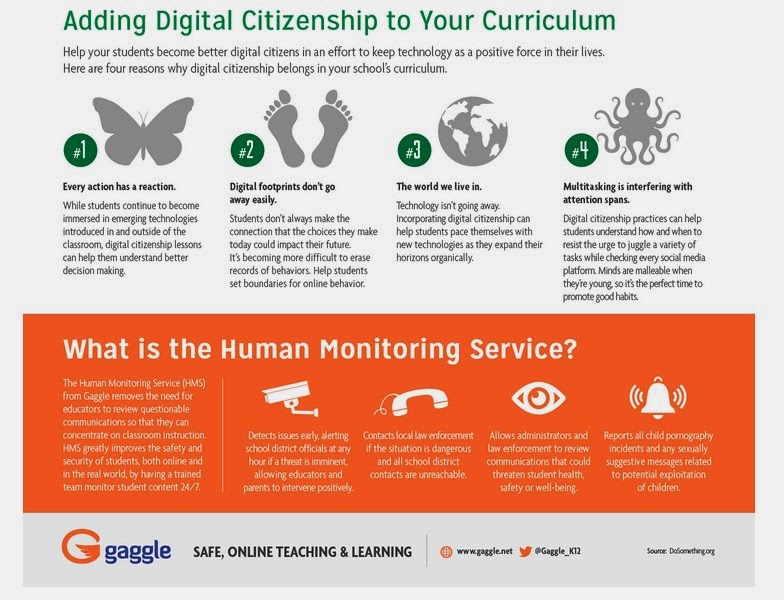
Here's a screen capture from Gaggle at https://www.gaggle.net/advantages/real-student-safety/ 


Yes, please tell me what is the HUMAN MONITORING SERVICE!?  It sounds despotic to me.  Then again, the FCC mandates it.  Wait, doesn't it make you uncomfortable, that phrase - Human Monitoring Service?  It does me.  What happens when you take your car in for a check-up?  Invariably, the technician finds something wrong.  It's the way the world works, if you're looking for something 'wrong', you'll find it every time.  Yes, it seems like a great thing that your child is being monitored, but it's not by you.  Do you trust everyone around your child when you're out of the picture?  I don't.  Surveillance such as this on children seems as rife to me with possibilities for finding 'behavioral' and 'discipline' problems as it does protection and if it doesn't to you, history proves your instincts wrong.  This kind of power is only as good as the entity that holds it - ever.


Another very concerning thing about Gaggle, is that it is Microsoft integrated.  Microsoft is responsible for the creation of something called SIF - Schools Interoperative Framework.  SIF is the road upon which all data travels to and from state and federal education offices.  If computers are the buildings, SIF is the road that connects them.  Data companies like EdFi who create 'dashboards' in order to pull in lots and lots of disparate data and conglomerate them in one place, use SIF to send out integrated student files anywhere - across any platform.  Here's a comment by a Colorado administrator, 
"Now, all of our data is in a map, schema, and organization that cross over our entire system for easy integration - today and in the future."  
As I mentioned before, any data that comes into these programs can be easily collected and shared across any platform and/or program - legally.

PORNOGRAPHY:  This is another screenshot from Gaggle I took at this URL  https://www.gaggle.net/advantages/real-student-safety/.  Please notice the built-in 'Anti Pornography Scanner' which scans everything your student could do on a computer...

It takes no real imagination to believe that because the program contains an anti-pornography scanner there would be a survey somewhere to capture whether or not students have had access to, or seen, porn.  Many of these programs can't be seen from the website.  Students must sign on to their accounts at school and that sign on brings with it entirely new access screens.  How will you know what your child is seeing under his sign on?

Blackboard has a unique program.  I took a screenshot of this as well.


See it, text it, document it...no one else sees anything to be concerned about there?  Oh, I know, I heard the same thing with the Patriot Act.  "I don't do anything wrong, so I don't have anything to be worried about."  WRONG.  Personal privacy is just that - PERSONAL.  Collection of this kind of information is not simply an invasion of your child's privacy, it's a direct attack on a student's First Amendment rights because anyone can consider anything 'hate speech'.  Your child may mean nothing by something they have said, but because someone else took offense, your child is now labeled a bully.  

I noticed a website in the lower left hand side of the page to the right of the orange bar - Make Beats, Not Beatdowns.  This website provides ways you can stop bullying while also outlining statistics - especially those regarding gay and lesbian bullying.  As a Christian, I can imagine one of my children going to school and, if asked, saying he/she believes homosexuality a sin.  Voila!  Expressing his/her religious views at school now makes them a bully and subject to clandestine texts to administrators who will then dole out sanctions deemed appropriate for such behavior.

Tiptxt also allows you to report "suspicious" behavior and "mental health" issues.  Please tell me what these are - they certainly aren't outlined on the website. That's the other problem with this stuff - it's completely nebulous and up to the person in charge to decipher and/or define.  School is now a place where your student's behavior must be absolutely consistent with the next student in order to prevent an incident report from creating a digital footprint they will never get rid of.  Erasing digital records is a tremendous feat not easily accomplished.

SCHOOL SURVEYS:  I linked to this article earlier, but I'm going to do so again.  Back in 2012 we published a short paper called, "Secretive and Unwarranted Psychological Testing of Children Does Occur With 21st Century Skills Programming".  I urge you to read it when you have a chance, but this is one kind of survey given to middle school students in conjunction with a federal grant program called the "21st Century Skills".  It is an open-ended survey that allows children to fill-in-the-blank with their thoughts and feelings which are then turned over to psychologists for review.

The most likely culprit for the survey Brooke describes in her video is the Youth Risk Behavioral Survey (YRBS), given to public school students by the CDC in grades 6, 8, 10 and 12th grades.  The Survey contains questions related to


Here are the problems with these kinds of surveys:
  • Parents MUST be notified that minor children will be exposed to this survey as part of the PPRA - Protection of Pupil Rights Amendment.  If you are not notified, you have legal recourse.
  • This information is simply no one's business but the parent.
  • Who's to say teenagers don't get more ideas from this kind of detailed survey than they had before they took the survey - education on sensitive issues should be done AT HOME BY A PARENT, not at school by relative strangers.
  • Brooke points out in her video that 'they' (the school) is trying to separate children from their parents.  The questions asked on these surveys are probing to say the least.  Many would be considered embarrassing by many students.  Once the child is exposed to this information it can become hard for them to tell their parents about it.  This creates a division between parent and child which is real and unconscionable.
  • The data for the YRBS is provided to the CDC which provides it to numerous other agencies such as the National Center for Education Statistics, and who knows whether individual students can be tracked through this survey.
I think I've proved Brooke's video statements true on all counts.  I hope, in the process, I've awakened any parents who are reading this to the eminent privacy dangers your child is exposed to in public schools.

WHAT CAN YOU DO?
  • Homeschool (without using a K-12 - or other - online program which are public in nature and therefore responsible for the same types of data collection and policies), or privately educate your children if possible.  Removing customers from the system is the only way to change the system.
  • Accept the evidence and realize your child's privacy is in jeopardy in public schools and work to change that.
  • Realize YOU THE PARENT have ALL the control.  If you don't want your child taking these surveys, inform the school - IN WRITING - you want your child opted out of the activities you desire and tell your child not to participate if the situation arises.
  • When you find misuses of your child's privacy, inform your school board in writing and then show up at the meeting to address the board with your grievances (FYI: you should attend your child's school board meeting every month anyway as one of your parental duties).  Also inform your state representative and senator because they can help with legislation to help stop data collection.
  • Do not sign a computer release for your child to use the internet at school unless you know EXACTLY what programs will be used and what data will be collected during their 'on' hours.
  • Enforce your parental right to direct the education of your child/children.  No matter what school officials say, they cannot induce a child to do something that is against the wishes of the parent (for the most part - your child cannot be truant for example).  Parental rights are universal and not granted by governments.  Know your rights and be prepared to stand for the privacy of your student when necessary.
Jenni White - 7/30/14