Showing posts with label data collection. Show all posts

1.25.2022

Six Reasons Why The Oklahoma State Legislature Should Ban The Use of SEL - Social Emotional Learning - Through SB1442


Last year, the state Legislature - prompted by outcry from parent and taxpayers across the state and the nation - passed HB1775, a rejection of the teaching of tenets tied to Critical Race Theory.

Unfortunately, CRT tenets are still entering classrooms around the state, packaged under the heading of Social Emotional Learning. We are seeking to remove SEL through SB1442 authored by Senator Shane Jett.

11.11.2021

Dr. Angela Grunewald's November 2nd Response To Parents, Is Either Deliberately False, Or Uninformed By Reality


In a post made to the Edmond Public Schools website, Superintendent Dr. Grunewald addressed what she characterized as "negative and sometimes false comments" made by parents at the 11.1.21 Board Meeting.  On the playground we used to say, "It takes one to know one."  Dr. Grunewald's response to parents in this missive is either deliberately false, or - worse - uninformed by reality.  Here's how we know.

4.03.2018

Public School Technology Costs Are Measured In More Than Millions Of Dollars


This morning I read an Op-Ed in the Norman Transcript written by several parents of Norman High School students - anonymously.
 
I want you to read the letter, but I want to make several points about this letter:

2.26.2016

There Is No Dana, Only Zuul - #GoOpen Open Source Initiative Will Make Every Kid The Same - Again


By Jenni White, Education Director, ROPE2.0

Wow. I honestly know why so many of my Common Core counterparts in so many states - awesome women who put their housekeeping/childcare hats on first thing in the morning and after putting the kids to bed in the evening, donned their 'outstanding researcher' hat - have quit fighting for public education. There is no winning the battle.

10.14.2015

October 7th Interim Study on STUDENT PRIVACY AND DATA COLLECTION


October 7, was the second interim study on Student Privacy and Data Collection at the Oklahoma State Capitol. Representative Jason Nelson called for the study and chaired a very enlightening and educational session related to the necessity of, and wherewithal to keep student data from being used alternatively to state law (HB1989).

Because of an accident in which I dislocated my knee, I was unable to be available at the Capitol, but I listened online through the OkHouse.gov website (here is the archived audio if you'd like to listen) and took copious notes over the speakers present. What follows is a very cursory - but hopefully legible - set of notes from the study. Please take the time to review these notes and the associated links. Please, realize that you as the parent have all the power here to keep your child safe. (As a legislator, you have quite a bit of information here by which to modify HB1989 to protect the privacy of Oklahoma students.) Know the educational programs/apps being used by your student at their school. Opt them out of any program/app that might collect your child's data - especially if you've not been informed of this kind of practice.

Don't forget...we've written a lot about student privacy - including this, "Student Privacy? What Privacy?". You may search our blog using any search terminology that interests you to find more information on this topic.

Speakers are listed in order from first to last. Please note: ROPE does not necessarily agree with all the comments made here. This is simply a transcript of what was said, not how what they've said - or not said - aligns with our own research and study.


*Bus routes, health/sports, lunches all have programs that usurp student personal data. Apps generate a lot of information about kids and then outsource that to third party vendors. For example; a kid uses Skype for a research paper at school. The transaction data is known by Skype. At any point, Skype can begin to develop information on a child that can be very revealing simply by taking enough data to reveal patterns.
*Google apps for education such as Google Docs are free programs for schools. What happens when a student writes an essay on terrorism and shares it? Where does that information go? Who sees it? Once it's on line, it can be data mined.
*The research Reidenberg has done indicate that 40% of all data vendors to public school had no legal obligation to protect student privacy. They also found that most programs haven't been vetted by anyone at the school.
********FERPA/Buckley Amendment: gets a FAILING GRADE at 40 years old. FERPA doesn’t provide privacy protection for students and families. There is a confidentiality statute for student/educational records – according to Supreme Court – but it only applies to a hard copy permanent record maintained by the school. It also only applies to school districts that receive federal funds. FERPA doesn’t apply to vendors. In fact, the only remedy under FERPA for a data breech is to withhold federal funds which has NEVER BEEN DONE IN 40 YEARS! Families have no rights under FERPA and the Supreme Court has made that abundantly clear.************************
*Vendors have no privacy responsibility. Vendor contracts have been studied and have been found to lack student privacy protections.
*The definition of "Educational Record"is a real problem under the law. So many things today are not classified under educational record, that families/schools have no recourse against vendors for student privacy breaches.
*Need to specifically and narrowly define ‘educational uses’ – when can student data be used? Should schools be supplying data to commercial operations to develop and devise various kids of commercial products? Commercialization of data from schools is just left by the wayside – rarely ever addressed.
*An Institutional Review Board process is not involved in any of the data collection programs/apps yet any legitimate research studies done on students/children/individuals have to follow IRB rules.
*Transparency for families is not being followed through FERPA. Public Records Requests don't work. In fact, 40% OF DISTRICTS INCLUDING Oklahoma City haven't responded to public records request.
*There are neither data security obligations nor remedies included in FERPA. States have a critical role to play – without effective student privacy protection, technology can’t be used without trust in the community.  An excellent example here is Connect EDU/InBloom.
*Congress hasn’t done anything on this, but really, the states should be leading the way on this because the kids live in the communities represented by the school misusing data. The consequences of state inaction on the issue of lack of FERPA compliance is that the state's children will be at a substantial risk of loss of privacy.
*States can be very effective when providing a student privacy officer through local schools.
*Anytime data is collected via computer via third party vendor it has a data dictionary and a code to identify what that information is to be used for. Data creep is a common problem – most companies start collecting information they don’t need now because they think they’ll need it later. This creates data breech/data loss. Data must be justifiably needed. Why collect if there's no justifiable reason?
*Need to add a ‘whereas’ clause to include the data to be used in the data sharing agreement and what the data is to be used for, etc. Where is the data going? Who needs it? Why is it being collected?
**********Helpful and necessary but not sufficient to have  a clause in the contract saying they would not share the data because it  would not address whether or not the company misuses the data or collects more than they need for commercial efforts. For example; the free email to schools program (Google) was data mining the emails to advertise to the kids. Google changed their policy to state they would no longer data mine for advertising, but we don’t know if they’re data mining for anything else. A clause in the contract saying they won’t share the data doesn’t fix this problem.**********
*We need to understand the difference between "Research Use" and "Transactional Use"
Transactional Use; child uses an edtech application to learn fractions. The program collects data while the child is using it by assessing the way the child interacts with the material; how long the child takes on one program, what problems they get right and wrong.
Research Use; the transactional data from lots of students are used to determine trends and in the math learning – to find a pattern. Done by data researchers.
*Two large dangers of data collection and how to guard against them:
  1. Data breech: data winds up anywhere because data wasn’t properly stored. Children’s identity theft is growing because kids have no prior records and thieves get clean data. Data must use a data breech identification and there need to be rules and regulations as to what happens if a data breech occurs.
  2. Need data purging rules/regulations: so many data systems we saw had no effective data purge rules. Student data sits there for a long time. If a kid is inappropriately tracked early on, how long does that information stay in their record and effect the child? Is there a statute of limitations for the use/collection of student data? State legislatures can put parameters on storage and uses.
Richard Lane – Director of the Education Division for the NGA Center for Best Practices (NGA Center)

*Need to have laws catch up with data use. 
*Three pillars for data use developed by Data Quality Campaign.
  1. Be clear on the purpose for  the use of the data:
  • Is it for the well-being of students to improve their learning by tailoring an education program to individual students and/or to find out how well a program is working?
  •  Is it to inform parents about how well the student is doing; test results, etc? What are their strengths and weaknesses?
  • Is is to provide accountability at local/state level?
     2.       Provide protections for data and use of data
  •  Need to be sure the data being collected aligns to the priorities of the district and state
  • Need to find the balance between appropriate use and protections
  • Need to train educators to use the data properly
     3.       Insure privacy of data
  •  Data ombudsman/data security officer needed to have a recourse as to how to solve the issue of data misuse.
  •  Need training in best practices
  • Should review the amount of data currently being collected and streamline data already being collected to prevent burdens on local districts for data collection.
*Legislation is important in student privacy protection. Ombudsman would communicate data use legislation to schools/districts/parents. 
*People need to be told about the effort so that people can buy in and use it and be protected.
*Student privacy is as much about implementation as policy. 
*Field educators need training and capacity to use data and protect data.

Lance Nelson - Chief of Staff, OSDE

*Can’t translate data outside the state or to other agencies with a very few exceptions.
*SSN medical/biometric/criminal/juvenile delinquency data not collected 
*FERPA allows for the transfer of student records to other schools. 
*Data is collected for study. Example: data are required to study report card. OSDE enters into an MOU with OU to provide the study and they will collect student level data.
*Use data for federal and state reporting. 
*No student level data is reported. 
*Student level data insures accuracy – makes sure we’re funding the schools at the proper rate. Without student level data it would be extremely hard to provide an A-F report card.
*Behavioral data is only aggregate data reported and sent out.

Nelson then goes on to explain what HB1989 says about what state agencies are to do with data.

*OMES stores data for OSDE but can’t use it for anything because of the OSDE/OMES data sharing agreement.

LEEA MOTE – OMES

*State department is working on metadata dictionary showing all data collections; what it does, why it’s being collected, where, etc.

Leea talked a bit more about how OMES stores data and then closed her portion of the testimony. If you would like to see a copy of her PowerPoint presentation, click here, go to page 5 and click on the interim study number, 15-100. A box will pop up. Click on Student Data Privacy Study presentation.pptx.

LEGISLATORS QUESTION THE PREVIOUS SPEAKERS
(Legislators in attendance included, Representatives, Strohm, Nolan, Coody, Nelson and Rogers)

Representative Chuck Strohm; Data security protocols were developed by?
Mote; Done by SIF. Nationally done.
Strohm; Is there work done to validate the security on the package itself and then another suite of testing done at the state level to make sure the system is secure? Are we doing a secondary test?
Mote; We have a security officer at the OMES. Don’t know his title, or what he does other than he monitors it and the OSDE is to do a risk assessment on their systems which is being done now.
Representative Jason Nelson1989 passed has the board run into situations where the law frustrated something that needed to happened that needs to be considered when we do amendments
David Kinney counsel ODE; I don’t have institutional knowledge but under 1989 board has promulgated policies and rules but don’t know of a specific instance that 1989 has frustrated any situation
Nelson; SLDS grants states received to create a data system, linking students/teachers/programs - what does grant allow to happen and what are we really doing? Should it be done at the state or local level?
Lance; personalized learning takes place where a student’s at and modifies curriculum to that student which is where computer programs are used. Tying student performance with teacher performance is TLE and we’re not there yet – being able to do that.
Nelson; Received SLDS grant in 2012 to link all state level data, is that the same kind of processes that a local district may be using now to personalize child’s education
Lance; linking data is for TLE
Nelson; 1989 required the list of all the data points collected in the wave and the definition for what that data is = metadata dictionary. 
The WAVE document does have that information in 150 pages – but a metadata dictionary isn’t just the WAVE but all data collections including that data out there already.
Can we get a list of all the data collections currently? Including what’s outside the WAVE - all data?
Motes; do have data descriptions though not as detailed as you’d like but you can see them.
Strohm; If there is a data breech and data stolen, do you have a protocol for dealing with that at the state level? Is OMES responsible since they house the data?
Motes; In the past, it wasn’t a data breech (that was the problem), it was something posted that shouldn’t have been. Did work with the agency to notify the students and families if the student was under the age of 18 so we did work in coordination with the OSDE to do that.
Strohm; Whose responsibility is it to manage after effects of data breech – notifying families and students..
Lance; Shared responsibility between OSDE and OMES. Would have to work together. OSDE doesn’t have technical capabilities. OSDE has lead role.
Strohm; What does OMES do with the data when it's purged? What is the contractual limitation on the data for purging with OU/OSU contracts?
Lance; OU/OSU purges data after research done. When a vendor is to do that, the vendor has to provide OSDE in writing that you’ve purged the data.
Strohm; If a project drags on with no end in sight, what is the time frame when the contract has to be re-evaluated? So data doesn’t sit out there where it could be harvested by unscrupulous people.
Kinney; If I understand contracts, there are time tables with deliverables and if the deliverables aren’t met, there are provisions.
Strohm; If we house classified data and we hand this data off to another agency/facility when you’re working with DOD data that facility also has to have a security  in place.
Kinney; If you’re using a computer service to look at data, the person using the data has to comply with the data use agreement.
Strohm; Is there an age of the child or time frame on the OMES data storage
Lance; I don’t know the answer to your question on time frame.
Nelson; Please send the answer to the committee. Need to know the answer. Can we get a copy of what the student data act requires – detailed data security plan and authorized access, etc (from 1989) – from the OSDE/OMES
Representative Jadine Nolan; Are there warnings when the system is trying to be hacked? Who knows this information?
Motes; We monitor potential hackers every day. None have affected OSDE, but there are potentials every day.
Nolan; All state systems – all state agencies?
Motes; We don’t have a number for those that have been breached but we can get from chief security officer and share.
Representative Michael Rogers; Does OSDE  provide policies for what data can be collected?
Lance; Nothing is collected other than required.
Strohm; So districts could have no policy about data being stored on an unsecured computer somewhere – is this possible?
Lance; Hypothetically yes.

Jana Burke - Chief Accountability Officer, Tulsa Public Schools

*Data sharing is so very important, performance driven, reflective…must measure progress and success with evidence, not doing our jobs…

Most of Burke's presentation was in the form of question and answers with the legislators as follows:

Nelson; What level of transparency is there in Tulsa if someone calls to ask what data is being collected?
Burke; Would provide information about their own child – must have FOI to tell what data we share. Very proud of the data we have because it accelerates student learning.
Nelson; Transparency a function of open records law but not pro active…relies on an FOI is there a regular channel/report/package of info developed that explains the kind of data collected?
Burke; I don't know, but accountability office at TPS could generate one immediately. Great idea to do to show parents to keep them from being concerned
Rogers; Does TPS have sites that collect more data than others?
Burke; Collected at a central sight because of (Pearson) PowerSchool and enrollment.
Rogers; Having a diverse district – how have you taken data and increased learning for students
Burke; Achievement scores don’t show the incredible amount of effort and proficiency but using specific student data, important information about teacher and school effectiveness can be unmasked by class and race for example.
Nelson; LDS concern about labeling kids follows kids and creates a bias down the road about the student. How do you guard against that kind of stuff? How much of a concern is that?
Burke; The teacher/administer relationship is effective. Bias comes from our own eyes - that’s the problem. Data is not the issue. Red Tape prevents teachers from having all the information on individual students. I am unaware of a situation in which the teacher found information in a student’s electronic file to create bias.
Strohm; Does TPS purge student data? How and when?
Burke; Outside organizations purge their data and evidence must be provided upon the termination of the contract. I don't know about the purging dates/periods on data current in the system. We need to have longitudinal data. We don’t want to cut off use to data that can help them making decisions.
Strohm; Is that data purged at graduation?
Burke; I don't know.
Strohm; It’s possible that kids coul  be 30 years old and have data still be in the system?
Burke; I don't think so. I'll have to find out that answer.

Tony Hutchison - Associate Vice Chancellor For Strategic Planning and Analysis

*Oklahoma state regents are governed by same laws as OSDE. 
*Very proud of data system – recognized nationally in Strong Foundations…Marion Dilbeck godfather of the system. 
*Top level security, quality of the data and efficiency
*Why do we collect data
  • Compliance with USDept of Ed to get aids and grants
  • Accountability reasons – graduation rates, etc – ethnicity/gender/
  • Predictive analytic – what can we do to improve student performance
*Want to follow privacy standards. 
*Individual level student data doesn’t really help them anyway – the real *Information is in the trends created by aggregating data in order to look at OTAG and other scholarships
*Endgame is always results. 
*The more data we have in terms of increasing the pool we’re looking at the better predictive modeling it can produce.

Strohm; How often do you get a request from a school district?
Hutchison; Used to get one or two a year, getting 2 or 3 a month maybe form the principal or super wondering about remediation issues – trying to figure out why so much remediation is in math.
Strohm; Are you using SSN?
Hutchison; We do use SSN voluntarily – 90% and that’s what lets us link to OESC records. OESC governed by more stringent privacy terms than Higher Ed.


Unfortunately, I missed most of Ryan's testimony. I have asked him for a transcript and if he provides one I will add. Otherwise, please use the link and instructions we have provided to go back and hear his comments.

One of his remarks centered on the fact that public schools are government schools and do we want the government having all that data.

Barmak Nassirian - American Association of State Colleges and Universities

*I'm addressing K12 because these students can’t provide informed consent. *Parental rights are important in this talk.
Privacy vs Security
*Privacy responses tend to be security responses.
*Instead of addressing data availability we need to worry about whether or not the database is really secure. 
*Data security is a very important concern.
*Privacy isn’t about who gets to use the data legally with authorization, it's should anyone have this right? Who should have access to your grades? 
*Just because they’re acting in an official capacity doesn’t mean they need official use of the data. Does a highway patrolmen need your grades to write you a ticket?
*Privacy is very rarely advanced by data disclosures. 
*Data collections and disclosures are appropriate - not just mechanical - but appropriate for each individual situation.
*Parent signatures must be the granting authority.
*With parental consent, everything is possible – the problem comes in when deciding which data is so compelling to get that its done without parent consent. *What information should parents know about in advance? Some information should be collected but which?
*The uses and applications of data must be communicated to parents and policymakers.
*Who has access to data?
*Mission creep is a real problem. Data collected for one purpose should not be used for another purpose without permission.
*We run the risk of cradle to grave system when all the child’s records can be added together to create correlations which don't really mean anything. *Correlations can create causality.
*Record retention again – how long do we keep the records.
*While data collections are increasing and subject to science – computer science – there is no science to back up the ‘science’ of collecting data in order to assist kids in their education.  
*We can’t make legitimate predictions from correlations. 
*Predictions are not actionable because they were based on comparisons, not actual causes.

9.03.2015

Why The ACT?


As many of our readers know, ROPE has not been supportive of state-sponsored ACT use. We believe ACT is a private-market test (no matter how the company would like to sell it) and parents and students should determine when to take it - even if they should take it at all.

Recently, State Superintendent Hofmeister made it possible for all Oklahoma 11th graders to take the ACT should they choose to do so (it is a voluntary action via school district). This was after the state legislature chose not to act on an end of year ACT exam last session.

This has left the question of "Why the ACT?" Why is it SO important to have Oklahoma students take the ACT? We're told it's because, as Mrs. Hofmeister has said numerous times, "Oklahoma is an ACT state", meaning (we infer) that the majority of students take the ACT and the majority of Colleges/Universities here in Oklahoma consider the results of the ACT for admissions.

Unfortunately, it's rarely noted that both OU and OSU start with grade point average and class position as their first necessity for admissions - NOT the ACT. Both OU and OSU take SAT as well as ACT. So if that's not what makes us an "ACT state", what does? Is it the fact that the ACT is sold most often to parents/students here in Oklahoma? What difference is that other than the result of a good marketing strategy?

Recently, the National PTA placed an article on its website called "Ten "Must Know" Facts About Educational Testing". Here, the PTA covers common misconceptions and provides information on various different types of testing. Number 7 was interesting, so I have pasted it below. Please remember, as you read this, that the Oklahoma PTA has been one of the staunch supporters of the ACT.

List of organizations in Oklahoma supporting the use of taxpayer funded ACT
Fact 7:Even though only about 25 percent of a student's success in college is related to the student's score on aptitude tests such as the ACT and SAT, parents should (1) still help their children prepare for those tests, but (2) avoid conveying a negative impression to a child whose test scores are not particularly high. The research evidence on this point is quite conclusive.
There are many factors far more influential than aptitude-test scores in predicting a student's college performance. A student's motivation, study habits, and interpersonal skills play powerful roles in shaping collegiate success. Parents should not think that a child who doesn't earn super scores on a college admissions test is destined for failure—in college or beyond. Numerous students who earn lofty scores on the SAT or ACT take an academic tumble when they get into college. There are many important kinds of intelligence, and the "academic" intelligence measured by most standardized aptitude tests is only one.
Action Implication:
First, if your child doesn't score well on the ACT or SAT, do not conclude that your child is "not bright." And definitely do not convey any such negative impression to your child. Second, because ACT and SAT scores do, in fact, play a significant part in current college admissions decisions, be sure to provide your child with at least some preparation for those tests
Goodness. The national PTA essentially says here that really, the kids who do best on the ACT are the ones that have test prep. Hmmmm. Now that we're providing all 11th graders with the ACT, the state will most certainly need to hire another private non-profit like Kaplan Test Prep or the scores won't be as good as they could be. Not only that, but even if the students don't do well on the test, poor results don't really mean anything in the context of a student's preparation for the world. Even retiring ACT president, John Erikson says,
"...but even if you think your test results don't reflect your grades and courses, your classroom achievements and dedication will overcome a poor test showing."
So why do we need to pay kids to take this test again?

Could it be then, that the reason why ACT is so heavily lobbying for Oklahoma to make ACT a 'state' test - and why the education establishment is kowtowing to this sales job - is because of the fact that everyone involved here will get a big fat chunk of data from every kid who takes the test? Yes, I think so. Data is power. As Arne Duncan so famously said, "Data drives decisions", and of course, the Oklahoma education establishment bought this idea hook, line and sinker. Yes, if we make ACT a 'state' test, the state will get a big fat package of student data and so will ACT.

ACT has its own entire division for data collection. Test takers have a supplemental data form they can fill out at the beginning of the test. ACT analyses this information in order to assist student placement in the best choices for them following graduation (college, trade school, etc.). They also have an entire division devoted to collecting data based upon test responses which then allows them to make 'predictions' about the body of test takers and their preparedness in each of the tested subjects. They also use this data to 'verify' assumptions about the validity of the test.

What in the world could state and federal governments do with these data but go on to create yet more - expensive and invasive - changes to the public education system, including more testing? In other words, education policy arises from data collected from tests that are then used to define education policy! It's a self-inflicted wound - a closed loop system.

Just recently, ACT released the data collected from students who took the ACT last year in their annual report. Though the Common Core panacea was supposed to have been instituted in states in 2010, the headline of the entire multi-page annual report would have to be,
"...based on data from a record 1.9 million ACT-tested students - nearly 60% of the 2015 US graduating class - shows very little change in overall college readiness over the past several years."
Interestingly, the SAT has very similar results to report,

Source: College Board, Created by infogr.am for EdWeek

Apparently, all the new federally subsidized and 'suggested' education fads aren't working. What else could these results underscore other than the COMPLETE AND TOTAL FAILURE OF TODAY'S EDUCATION REFORM POLICIES? Apparently, the constant testing pummeling students today in the name of education accountability isn't helping anyone but the bottom line of the testing companies. It's SURELY and OBVIOUSLY not helping the kids. If parents want students to take college readiness tests, parents should either pay for them out of their own pockets, or apply to ACT for a grant to do so. States should not be using hard-earned tax dollars to pay for a test that - at best gives them an idea of what they do and don't know - they should be using those tax dollars to support great teachers and TRADITIONAL educational methods that have been shown to work for decades.

2.15.2015

There Is No Such Thing As De-Identified Data! Your Child's Privacy Is At Risk.


Though we've researched it to be sure, and said over and over again it wasn't true, ROPE (and parents) have been assured by public school data gatherers such as John Kraman (formerly the Executive Director of Student Information at the Oklahoma State Department of Education, now the Senior Advisor for Education & Workforce at the LARGEST DATA COLLECTION CENTER IN OKLAHOMA, Office of Enterprise and Management Services- OMES - the Director of which was recently arrested on an alcohol complaint with a woman apparently not his wife in the car) that public schools could take whatever data they 'needed' from our children because once it was 'aggregated' or 'de-identified', our children's privacy would be safe. 

This document - from an organization created by the federal government (the same one that changed FERPA laws to mean nothing for student privacy) tasked to provide information on how to protect student data - provides exactly these talking points while explaining what de-identified data means. 

Maybe we'll start getting some traction on our argument after legislators, parents and public school officials watch the following video, however, taken from testimony to the Subcommittee on Early Childhood, Elementary, and Secondary Education during a hearing called, "How Emerging Technology Affects Student Privacy".  


Lynn watched a huge chunk of this testimony (attended by OK Congressman Steve Russell). She identified a number of very good places to watch for information, but the best information BY FAR, was provided by Joel R. Reidenberg of Fordham University. At 1:30 on the video, Mr. Reidenberg says, 
"...you can reverse engineer identity with a few characteristics..."
and
"25% of school contracts were not paid with by cash, they were paid with using their student's privacy - information for services"
This should SHOCK AND CALL TO ACTION EVERY PARENT WITH A CHILD IN PUBLIC SCHOOL.

Here are some other quotes from other places on the video that might interest you:
  • 55:30 - Alison Knox of Microsoft says, "the third party provider must articulate how the data flows and who has access"
  • 1:02 - Knox talks specifically about how marketers get student information and what happens if 3rd party contract terms are not clear
  • 1:31-1:38 - Steve Russell explains that dis-aggregated data is a myth
  • 1:38-1:39 - Representative Grothman gives examples regarding Google and how Google apps are getting student information because the application is free. He gives examples of the information Google gets and how they use the data to develop products. He also gives examples of how non-transparent the process is and how they can use data in ways not stated in the contracts.
  • 1:40 - Ms. Sevier explains that PARENTS DON'T REALIZE THEY ARE GIVING UP THEIR STUDENT'S INFORMATION
  • 1:47 - Mr. Reidenberg says parents/school officials must be careful of 'forced consent' when a student has to click "accept" and waive their privacy rights to participate in their own education.
We are living in an age where data is becoming all there is to teaching. All we seem to hear about is 'data driving decisions/instruction' - goodness, what did America do to become the foremost economy in the world before there were computers to tell teachers how to teach and children how to learn! I can't believe we were even able to put a man on the moon with the paltry technology available in the 50's and early 60's!

Today, we have a data collection network across Oklahoma that would be a wonder to behold, if it weren't creating data privacy issues for students ALL OVER OKLAHOMA. Just click here to see a PowerPoint presentation put together by John Kraman detailing all the many committees and process by which the state (under Kraman's direction) will collect information on your children. 

It is clear that often, teachers have no idea what kind of information the programs they are being told to use in their classrooms collect. It's clear even principals and superintendents don't have this information. Certainly, it seems as though there are school staff that DON'T WANT parents to have access to this kind of information and that is troubling.

Consequently, it's CLEARLY all up to PARENTS to determine to what their children are exposed to at school. 

Here is an online version of the Parental Bill of Rights passed last year. Please download a copy, read it and USE IT. Pass the information on to your school's staff and other parents. We must be informed if we are to stop the assault on the rights of students to their own - and their family's - privacy. Become your child's own privacy advocate today!

1.19.2015

The Student SUCCESS Act or NCLB Lite?


Just recently, I was asked to critique the Student Success Act. The SSA is on track to become the re-authorization of the NCLB - President George W. Bush's re-authorization of the Elementary and Secondary Education Act (ESEA) installed by LBJ in 1964.  If you'll recall, the Obama Administration has been loathe to re-authorize NCLB as they have found it much easier and more effective to supplant state control of education by creating federal interventions into local public education by means of enticements (Race to the Top, etc.).

Unfortunately, while I believe there are a few good things about the SSA, the upshot is that the federal government apparently still doesn't understand it's Constitutional role. The entire bill is political in nature and wholly unnecessary. The Constitutionally proper thing to do is to repeal NCLB entirely, thereby putting the confederation of states we call the United States, back in charge of educating their own children in the manner their taxpaying citizens see fit. Obviously, the federal government has no Constitutional authority here and the interventions in public education at that level cannot possibly be better than anything a state would choose for its' children, as the state is closer to the voter/taxpayer/parent than any bureaucrat in a chair in Washington, D.C. Any federal level intervention in public K-12 education can do nothing but remove the ability of parents to fully direct their child's education according to their own desires and what is best for each individual child.

I reviewed the floor summary of the bill and as such, will arrange my comments according to the layout of that document.

Returning Responsibility for Student Achievement to States, School Districts, and Parents, While Maintaining High Expectations

  • Academic Standards: By dictating FROM the federal government that states MUST use standards, this bill opens the door to Common Core (1). As we have found under RTT, states will most often use the PATH OF LEAST RESISTANCE and choose a set of standards being pushed by either private vendors or the feds. Either way homogeneity in standards is the likely outcome. * I am most often offended by this bill's often use of the phrase, "States are ALLOWED". WRONG. States have ALL the power. Period. Reading the Constitution comes in handy here.
  • Academic Assessments: By dictating FROM the federal government that states MUST test students over their standards - even going so far as to dictate the grades in which students should be tested - you have changed NOTHING under the current NCLB law. In fact, the last sentence of the paragraph dictates that 95% of students must be tested. Again, no different than NCLB. This one prevision in NCLB PREVENTED PARENTS (2) from opting their children out of state testing if they so desired. Schools made the argument that it was a federal mandate to test their student, therefore, opting out was not an available option - TO PARENTS - the people who have ALL CONTROL over their children in every legal sense of the word. How is this NOT egregious? ("states retain the OPTION", "states...are ALLOWED")
  • Accountability: Removing AYP is a GOOD THING. However, the bill still dictates a system be used by which to grade school performance. This is the A-F metric used here in Oklahoma. As we have shown previously, the metrics in ANY school grading effort are ill-defined at best and excessively punitive at worst. If students take a national proficiency test like IOWA (4), parents will know how well THEIR child is doing in relationship to other students of the same age. Parents don't need to know how well their school is doing, just how well their individual CHILD is doing. The grading system can't help but open the door to cheating as surely as did the AYP score. A composite or average score of IOWA test scores could be used for each grade for parents wishing to identify schools with high performing students - which is the issue.
  • School Improvement: Though SIG grants are eliminated (a GOOD THING) and the legislation mandating school improvement mechanisms is repealed (a GOOD THING), the bill still dictates states use a system of school improvement interventions for poorly performing schools. This is ridiculous to continue at any federal level for two reasons: School turnaround efforts have been shown NOT TO WORK (5) and open enrollment and school choice would likely eliminate the issue of poorly performing schools altogether. In addition, set-asides were a hotly contested item in Oklahoma's Common Core repeal by administrators who often use this money for uses other than that outlined for the set-aside, schools become dependent upon the money and then use it as an excuse for why laws (in this case the NCLB waiver) must be kept.
  • Parent Information:  Parent information should not be dictated at the federal level. This is a BAD THING. This entire paragraph supports the State Longitudinal Database System (SLDS) which is pulling TONS of personal, private data from individual students through individual district schools through the state to the federal government (6).  ALL personal, private student data  (7) should be kept at the STATE level only. The DOE has access to NAEP (8) scores and that's all they should have under the guise of 'protecting' students and 'informing parents'.
  • State Laws On Parent Authority: reiterating that federal law cannot impact state laws dictating parental rights is a GOOD THING.
  • Funding Flexibility:  Again, the feds ALLOW states? At any rate, it appears that there will be block funding for "special population" programming.  While block granting is a good thing (though not better than not taking the money from taxpayers in the first place!) 'special population' programming is a BAD THING. Again, this supports the SLDS and collects information on groups the federal government gets through the Census and only serves to collect MORE data on students (9) at the personal level without providing states anything they shouldn't already know more about and be more prepared to deal with.
  • Schoolwide Programs:  This eliminates the 40% poverty threshold...anytime the federal government DIVESTS itself of public control it is a GOOD THING.
Eliminating Ineffective Federal Programs and Investing Limited Taxpayer Dollars Wisely
  • Authorization Levels:  Unless I know specific numbers, all this section says is that the feds won't give the states back some of the money it takes from taxpayers to apply to the education of their children. Baloney - leave the money in the pocket of the taxpayer so they can decide which SCHOOL/DISTRICT/STATE can provide the best education for their child. Leaving money with the taxpayer provides SCHOOL CHOICE.
  • Eliminated Program:  GOOD THING.
  • State and Local Innovation:  Creates a NEW Local Academic Flexible Grant. BAD THING. This GROWS GOVERNMENT. Again, leave thee money in the hands of the taxpayer - don't take it from him and give it back with strings attached. After school activities are for PRIVATE and COMMUNITY organizations - including churches - to take on. *In addition, the grants will can be used for "efforts to protect student safety". BAD THING.  Protecting student safety is a program called Safe and Drug Free Schools. Among other issues, it comes complete with a database that tracks bullying - including LGBT (10). The Safe and Drug Free Schools initiative is responsible for collecting data at the federal level from LOCAL districts. Oklahoma has hundreds of fields in our SLDS devoted to Safe and Drug Free Schools data. Many of these fields are subjective and include BEHAVIORS which then go onto a student's permanent record, harming their ability to be a success in the future when electronic transcripts are easily shared among schools and, thanks to the holes in FERPA (11), with anyone who can be identified as school-associated, including volunteers.
  • Private Sector Initiatives: Dictates that states must reserve 10% grant monies to use in private sector, but again, leave money with the taxpayer.
  • State and Local Spending Decisions:  This looks as though it amounts to a block grant in essence. This is a GOOD THING, but not as good as leaving the money with the taxpayer. The section the goes on to say that to 'protect the traditional federal role in education' federal money 'supplements' state money. First of all THERE IS NO TRADITIONAL FEDERAL ROLE IN EDUCATION. Secondly, state money has always come first - except in Title 1 - so that part makes little sense.
  • Department Bureaucracy: GOOD THING because it reduces employee positions associated with eliminated or consolidated programs.
  • Program Evaluations:  BAD THING.  Directs Secretary of Ed to work with Institute or Education Sciences (IES) to perform evaluations on federal education initiatives. This portion of the bill absolutely ENSURES the further collection of student level data (12) in the name of 'accountability'. The only data collected at the federal level - until we rid ourselves of the DOE altogether - should be the NAEP.
  • Earmarks:  Stops earmarks to comply with House earmark ban. GOOD THING.
Strengthening Programs for Schools and Targeted Populations
  • Education of Migratory Children
  • Prevention and Intervention Programs for Children and Youth who are Neglected Delinquent, or At-Risk
  • English Language Acquisition, Language Enhancement and Academic Achievement
  • Rural Education
  • Indian Education
  • BAD THING.  NONE of these categories should be addressed at the federal level. Look at the wording used, "TARGETED". The federal government should not be targeting any "population" or "category" for any kind of data collection. Separating people into groups and then providing separate funding streams to facilitate the collection of data is completely wrong. The Prevention and Intervention Programs for Children and Youth...is the worst because of the individual, personal student data collected - information about guns, weapons and very subjective categories of behavior (see citation #9) - do not belong on a personal, electronic, shareable, record at the federal level when all information is best left to states to collect IF NECESSARY. In 2010, Congressman John Kline sent a letter to Arne Duncan (13) accusing him of creating a De Facto national database (establishment of which is against federal law). If Chairman Kline felt that way in 2010, this continued data collection should have stopped at that point and definitely should not be continued at the federal level. In fact, there is a Federal Law that prohibits the collection of data (14) that could be considered a national database.
Supporting Local Efforts to Measure Teacher Effectiveness
  • Highly Qualified Teachers: GOOD THING. Repeals federal requirements for teacher certification.
  • Teacher Evaluations:  BAD THING. Teacher evaluations KEEP COMMON CORE ENTRENCHED (15) because the data collection models often point back to specific ways of teaching CC. Also, these systems include the collection of behavioral data on students which compromises student privacy (16). This kind of data is also subjective and can be used by school administrators as an excuse to fire teachers for ideology. There is no reason for the federal government to prescribe this action for states. Principles are hired by local school boards. These individuals are trained/certified to conduct evaluations on teachers in order to make employment decisions. This kind of law REMOVES LOCAL CONTROL by circumventing the school board process made up of local parents and community members.
  • Uses of Funds:  Frees up existing  funds to be spent on whatever system the state imposed for teacher evaluations. Evaluation same as above - money needs to go back to the state and let local school boards make decisions on teacher employment.
  • Teacher and School Leader Innovation:  Consolidates remaining teacher quality programs into a new grant - Teacher and School Leader Flexible Grant. BAD THING. As with the previous grant program creation evaluated (Local Academic Flexible Grant), this grant will also GROW GOVERNMENT and cut out local control. States will apply, feds will say what to do with the money and parents will get caught in the middle. As Lindsey Burke of Heritage Foundation writes in "The Dead Hand of Federal Education Reform" (17),
    • Completing grant applications, monitoring the federal program notices and complying with reporting requirements siphons away huge amounts of educators' time and money - resources THAT WOULD BE MUCH BETTER DEVOTED TO THE CLASSROOM.
  • Teacher and School Leader Academies:  The U.S. already has enough issues with teacher preparation not being rigorous enough (18) while charging students a pretty penny for tuition. All that is really needed is a long-term (one school year?) on-the-job-training (student teacher) assignment. No money is required for this kind of preparation.
  • Teacher Liability:  Anything included under this category would be unnecessary as this is a state matter provided for by individual state law.
Engaging Parents in their Child's Education
  • Charter Schools
  • Direct Student Services
  • Magnet Schools
  • Family Engagement Centers
  • BAD THING. None of the above are needed as what parents demand/expect of/for their children's education is SOLELY A LOCAL MATTER. Again the federal government  is going to dictate to states that they set aside money for competitive grants which are better off left to private organizations or churches in the community. (19) Again, the federal government should not be taking taxpayer money and then doling it back out to them through another state tax-supported government office. *The Family Engagement Centers are particularly noxious as these are the kinds of places where excessive data collection is occurring (20). The school is not and should not be the center of the family (21) - the FAMILY (or the church) - is the center of the family. 
Supporting Impact Aid
  • Payments for Federal Property
  • Payments for Federally-Connected Children
  • Timely Payments
  • The only one here I have an issue with (though, again, Constitutionally, all the money collected for education at the federal level should be returned to the state and ultimately taxpayers in order that they may be better able to educate their children) is the Payments for Federally Connected Children. Again, the reason is personal data collection on children. My goodness, just read the verbiage used in this paragraph..."count children", "counting children".
Maintaining and Strengthening Long-Standing Protections for State and Local Autonomy
  • Secretary's Authority. It would have been best to scrap ALL of the current NCLB law and simply enact this section as law.  GOOD THING.
  • Private School Students: BAD THING. The Blaine Amendment (22) is the exact reason why the federal government should have absolutely NO SAY in PRIVATE EDUCATION ever. This is a local/parent/state matter. The Blaine Amendment has caused considerable issues with school choice - federal intervention in state matters often causes similar ills - therefore this section should be left out completely and all references to private education repealed.
  • Military Recruiters: Germane?
Providing Services for Homeless Students
  • Improved Collaborations
  • School Stability
  • This portion of the bill refers to the McKinney-Vento Homeless Assistance Act. BAD THING. This section should be removed. Data collection on the homeless is provided by the Census. Allowing the federal government to collect data on homeless children, is again, providing the federal government with more data than they need on individual children and states. This is a STATE/LOCAL issue best addressed through local private charities and churches and state-run facilities. See citation #9 for all the information on M-V data collection. For the money states get for this particular grant, schools must take time and resources away from classroom activities in order to collect the data required. Associations with organizations at the local level are in the best position to help with the least amount of red-tape, providing better services, faster.

CITATIONS

(1)  Is Common Core Meant To Blow Up The American Educational System? 
(2)  FairTest.org - How NCLB Relates To Opting Out Of Tests: 
(3)  Oklahoma's A-F Grading System Gets An "F"
(4)  Seton Testing services including IOWA tests: http://www.setontesting.com/iowa-tests/
(6)  An Analysis Of Recent Education Reforms and The Resulting Impact On Student Privacy:
(7)  Does Our State Superintendent Truly Care About Student Privacy? 
(8)  National Assessment of Educational Progress:  https://en.wikipedia.org/wiki/National_Assessment_of_Educational_Progress
(10)  Office of Safe and Drug Free Schools database in EdFacts:  http://www2.ed.gov/about/inits/ed/edfacts/edfacts-overview.pdf
(11)  Federal Register; FERPA
(12)  Surveys and Programs Listed under National Center for Educational Statistics;
(13) Letter from Congressman John Kline to Arne Duncan
(15)  Seven Reasons Why Common Core Repeal in Oklahoma Isn't. 
(16)  I'm Outraged and You Should Be Too - Private Student Data On Google Docs For All To See
(17)  The Dead Hand of Federal Education Reform: 
(18)  Training Our Future Teachers:  http://www.nctq.org/dmsView/EasyAs
(19)  Whiz Kids: http://www.whiz-kids.org/
(21)  A Review of the Partnership for 21st Century Skills White Papers

7.30.2014

Student Privacy? WHAT PRIVACY?


I'm warning you, this will be a LONG post, but EVERY PARENT should go through it with a fine tooth comb.

First, I want you to see this VERY SHORT video of Louisiana parent, Brooke Falgout, describing objectionable content in her parish school.

Brooke has apparently received some fallout from this video - parents intimating that what she's describing isn't true because they've never seen anything like this, or their children (who live in the same Parish) haven't told them anything like this, for example.  Fine, everyone is entitled to their thoughts on the topic, but I want to ask a few questions:


  • How much do you know as a parent/guardian about what actually happens in the classroom?
  • Have your kids ever neglected to disclose information to you because a) they were uncomfortable telling you or b) (this is my favorite) they didn't think it was a big deal?  I have.
  • Do you feel yourself educated enough as a parent to know exactly what you're looking at if you were to see something like Brooke is describing staring you in the face?  Translation; do you know what words like "Cyberbullying" really mean in school terms?
  • Do you feel yourself educated enough about the change in FERPA laws that allow data to be collected from all across the web - so long as it can be considered a function of 'learning' - that you know exactly where your child's data is going the minute they log on to any computer in the school?
As a researcher, the minute Brooke began to speak, I got her on camera for one reason - I've seen exactly what she talked about first hand and through my associations with other parents - worse, if you want to know the truth.  Also, as a researcher, after getting Brooke on video, I went out to the websites Brooke reported, poked around and found just what she talked about - and more.

In order to understand what I will say next, you must - sadly - suspend the notion that schools have the best interest of your child at heart.  I know that statement is harsh, but, again - sadly - it is reality today - not out of any desire to harm children - but more as a result of several ongoing conditions:
  • MANY state and federal mandates put teachers and schools in the unenviable position of intermediary.  Many times teachers/administrators are forced to use computer programs or data collection materials in order to get continued funding, or avoid censure of some kind.  Many times neither the teachers nor administrators know exactly what the program does or where the input data goes after it's entered.  Data collection for the Safe and Healthy Schools Program - and 16 other data collection programs - are mandated by the federal government.
  • MANY administrators have developed the idea that buying new and 'better' programs - ironically marketed to them by companies who have developed the programs utilizing student data collection - help run their schools more efficiently while simultaneously creating excitement among parents for the supposed result of the program - school safety for example (do you have to get in your school via a fingerprint/badge?)
  • MANY teachers today are entering the classroom having been indoctrinated in the notion that 'data drives learning' (a pile of drivel immediately disproven by the knowledge that America put men on the moon with rudimentary computers programmed by men just decades out of the one room schoolhouse) and therefore have no compunction about sitting a kid down at a computer for hours in a day in the name of 'learning'.  These teachers may know the amount of data being collected on that student - or know exactly what's in a video - but believe this data will help her better teach that student, and/or the child needs instruction in cyberbullying or alcoholism or fill-in-the-blank, because he/she's sure the child is not going to get that super important instruction at home.
Brooke reported the names of three websites used by her daughters' school:
1.  Gaggle
Brook alleges her daughter had to take a survey that covered:
1.  Cyberbullying
2.  Pornography
3.  Personal questions her family life including details such as whether or not they were given snacks after school
CYBERBULLYING:  Here is a screenshot I took from the EverFi website at the URL http://www.everfi.com/ignition


You may have to click on the picture to enlarge it, but please notice that third down it says "Cyberbullying".  Under "Rich Assessment Data" it says, "Data on student knowledge gain and BEHAVIOR (emphasis mine) change can be shared with key stakeholders.  Ignition helps K-12 districts meet the FCC requirements to educate about Internet safety in order to comply with federal e-Rate..." then it stops.  Consequently, I went out the internet to look this up (good thing my computer doesn't have all these exciting internet filters!).

Apparently, in 2000, the FCC implemented the Children's Internet Protection Act.  Schools and libraries who want to receive e-Rate grants (a fund created by Al Gore's cell phone tax to help schools/libraries get funds to install internet or to increase broadband width - handily available for schools needing to update to take the new and exciting Common Core tests) must provide filters to protect students from materials on computers that are (a) obscene; (b) child pornography; or (c) harmful to minors.  The federal government upped the ante, however, with the Protecting Children in the 21st Century Act Amendment, that directs schools to provide certification of programming that will monitor student online behavior and
"provide for educating minors about appropriate online behavior, including interacting with other individuals on social networking websites and in chat rooms and cyberbullying awareness and response"
before the school/library can receive e-Rate funds.  You can find more information on these Acts here.

So?  What's the problem here?  I don't want my kid able to look at porn on the computer at school.  I don't want my kid to be cyberbullied.  Here are just some of the problems associated with these 'Acts":
  1. What is "appropriate" online behavior?  There is no definition.  It's arbitrary.  So, if your kid isn't liked at school, how easily do you think THIS could get he/she in trouble, ESPECIALLY since schools must monitor student internet use and RESPOND (discipline) to these incidents.
  2. If kids don't know what 'porn' is, the federal government makes sure the school will have to tell kids what pornography is so they know not to get on to pornographic sites.
  3. Read these Acts - they are FULL of loopholes that keep the laws from being followed by the schools and libraries anyway, yet internet software developers like EverFi are going to create the need for the software ("Look, you have to have this program if you want your government money") and sell it while unsuspecting administrators (or those with an agenda) will buy them to use on your kids.
  4. Do you think teachers go through all this stuff and know the ins and outs?  I'd be mad if they did because they should be teaching my kid actual subjects and not made up subjects to mire his mind in garbage.  How much time is this stuff stealing from actual classroom learning?  
  5. There is another federal program called Safe & Drug Free Schools that collects a great deal of data on students in public schools regarding disciplines, behaviors, etc.  These kinds of programs are perfect for populating that database.  Once your child is 'identified' as a cyberbully, they will carry that on their permanent record.
Just so you know I don't have an over-active imagination, I captured the following screenshots from the EverFi website as well.  If you go to their main page, click on the 'solutions' tab at the top of the page and then click on 'health and wellness' you'll find programs for alcohol prevention and sexual assault prevention.  I clicked on sexual assault prevention  and then 'learn more'.  This is what I found.


This program, called Haven, is supposed to be for college students, yet it's on the same website as the Ignition program for middle school kids.  If you choose to teach your children that homosexuality is not a 'healthy relationship' I guess you're in trouble.  Oh, and by the way, students are taught to intervene (tattle on) in any 'unhealthy' discussion relating to 'healthy relationships'.  What is a "healthy relationship"?  On what grounds do students 'get to' intervene?

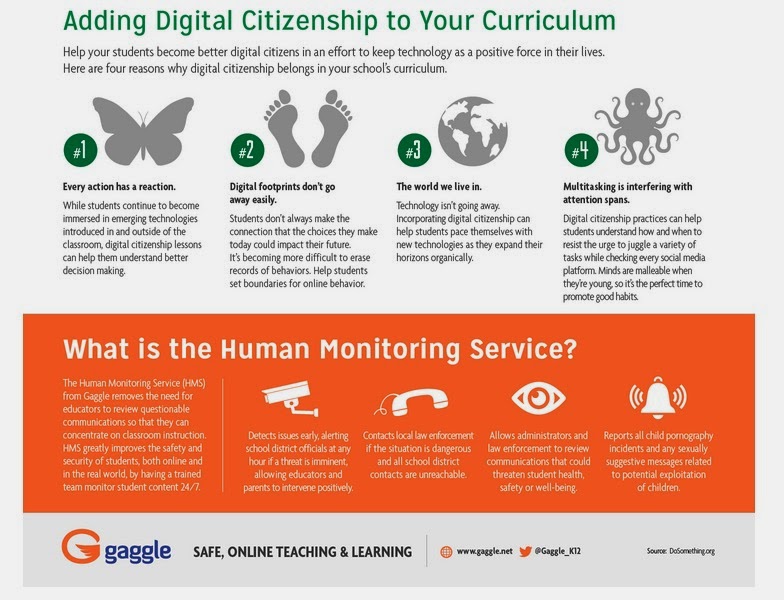
Here's a screen capture from Gaggle at https://www.gaggle.net/advantages/real-student-safety/ 


Yes, please tell me what is the HUMAN MONITORING SERVICE!?  It sounds despotic to me.  Then again, the FCC mandates it.  Wait, doesn't it make you uncomfortable, that phrase - Human Monitoring Service?  It does me.  What happens when you take your car in for a check-up?  Invariably, the technician finds something wrong.  It's the way the world works, if you're looking for something 'wrong', you'll find it every time.  Yes, it seems like a great thing that your child is being monitored, but it's not by you.  Do you trust everyone around your child when you're out of the picture?  I don't.  Surveillance such as this on children seems as rife to me with possibilities for finding 'behavioral' and 'discipline' problems as it does protection and if it doesn't to you, history proves your instincts wrong.  This kind of power is only as good as the entity that holds it - ever.


Another very concerning thing about Gaggle, is that it is Microsoft integrated.  Microsoft is responsible for the creation of something called SIF - Schools Interoperative Framework.  SIF is the road upon which all data travels to and from state and federal education offices.  If computers are the buildings, SIF is the road that connects them.  Data companies like EdFi who create 'dashboards' in order to pull in lots and lots of disparate data and conglomerate them in one place, use SIF to send out integrated student files anywhere - across any platform.  Here's a comment by a Colorado administrator, 
"Now, all of our data is in a map, schema, and organization that cross over our entire system for easy integration - today and in the future."  
As I mentioned before, any data that comes into these programs can be easily collected and shared across any platform and/or program - legally.

PORNOGRAPHY:  This is another screenshot from Gaggle I took at this URL  https://www.gaggle.net/advantages/real-student-safety/.  Please notice the built-in 'Anti Pornography Scanner' which scans everything your student could do on a computer...

It takes no real imagination to believe that because the program contains an anti-pornography scanner there would be a survey somewhere to capture whether or not students have had access to, or seen, porn.  Many of these programs can't be seen from the website.  Students must sign on to their accounts at school and that sign on brings with it entirely new access screens.  How will you know what your child is seeing under his sign on?

Blackboard has a unique program.  I took a screenshot of this as well.


See it, text it, document it...no one else sees anything to be concerned about there?  Oh, I know, I heard the same thing with the Patriot Act.  "I don't do anything wrong, so I don't have anything to be worried about."  WRONG.  Personal privacy is just that - PERSONAL.  Collection of this kind of information is not simply an invasion of your child's privacy, it's a direct attack on a student's First Amendment rights because anyone can consider anything 'hate speech'.  Your child may mean nothing by something they have said, but because someone else took offense, your child is now labeled a bully.  

I noticed a website in the lower left hand side of the page to the right of the orange bar - Make Beats, Not Beatdowns.  This website provides ways you can stop bullying while also outlining statistics - especially those regarding gay and lesbian bullying.  As a Christian, I can imagine one of my children going to school and, if asked, saying he/she believes homosexuality a sin.  Voila!  Expressing his/her religious views at school now makes them a bully and subject to clandestine texts to administrators who will then dole out sanctions deemed appropriate for such behavior.

Tiptxt also allows you to report "suspicious" behavior and "mental health" issues.  Please tell me what these are - they certainly aren't outlined on the website. That's the other problem with this stuff - it's completely nebulous and up to the person in charge to decipher and/or define.  School is now a place where your student's behavior must be absolutely consistent with the next student in order to prevent an incident report from creating a digital footprint they will never get rid of.  Erasing digital records is a tremendous feat not easily accomplished.

SCHOOL SURVEYS:  I linked to this article earlier, but I'm going to do so again.  Back in 2012 we published a short paper called, "Secretive and Unwarranted Psychological Testing of Children Does Occur With 21st Century Skills Programming".  I urge you to read it when you have a chance, but this is one kind of survey given to middle school students in conjunction with a federal grant program called the "21st Century Skills".  It is an open-ended survey that allows children to fill-in-the-blank with their thoughts and feelings which are then turned over to psychologists for review.

The most likely culprit for the survey Brooke describes in her video is the Youth Risk Behavioral Survey (YRBS), given to public school students by the CDC in grades 6, 8, 10 and 12th grades.  The Survey contains questions related to


Here are the problems with these kinds of surveys:
  • Parents MUST be notified that minor children will be exposed to this survey as part of the PPRA - Protection of Pupil Rights Amendment.  If you are not notified, you have legal recourse.
  • This information is simply no one's business but the parent.
  • Who's to say teenagers don't get more ideas from this kind of detailed survey than they had before they took the survey - education on sensitive issues should be done AT HOME BY A PARENT, not at school by relative strangers.
  • Brooke points out in her video that 'they' (the school) is trying to separate children from their parents.  The questions asked on these surveys are probing to say the least.  Many would be considered embarrassing by many students.  Once the child is exposed to this information it can become hard for them to tell their parents about it.  This creates a division between parent and child which is real and unconscionable.
  • The data for the YRBS is provided to the CDC which provides it to numerous other agencies such as the National Center for Education Statistics, and who knows whether individual students can be tracked through this survey.
I think I've proved Brooke's video statements true on all counts.  I hope, in the process, I've awakened any parents who are reading this to the eminent privacy dangers your child is exposed to in public schools.

WHAT CAN YOU DO?
  • Homeschool (without using a K-12 - or other - online program which are public in nature and therefore responsible for the same types of data collection and policies), or privately educate your children if possible.  Removing customers from the system is the only way to change the system.
  • Accept the evidence and realize your child's privacy is in jeopardy in public schools and work to change that.
  • Realize YOU THE PARENT have ALL the control.  If you don't want your child taking these surveys, inform the school - IN WRITING - you want your child opted out of the activities you desire and tell your child not to participate if the situation arises.
  • When you find misuses of your child's privacy, inform your school board in writing and then show up at the meeting to address the board with your grievances (FYI: you should attend your child's school board meeting every month anyway as one of your parental duties).  Also inform your state representative and senator because they can help with legislation to help stop data collection.
  • Do not sign a computer release for your child to use the internet at school unless you know EXACTLY what programs will be used and what data will be collected during their 'on' hours.
  • Enforce your parental right to direct the education of your child/children.  No matter what school officials say, they cannot induce a child to do something that is against the wishes of the parent (for the most part - your child cannot be truant for example).  Parental rights are universal and not granted by governments.  Know your rights and be prepared to stand for the privacy of your student when necessary.
Jenni White - 7/30/14